One afternoon, a worried pet owner rushed into a veterinary clinic with a sick puppy. On the wall hung a certificate showing DVM, while another clinic nearby displayed VMD. The owner wondered if one doctor was more qualified than the other. In reality, both titles represent highly trained veterinarians who care for animals.
Understanding the difference between DVM and VMD helps students, animal lovers, and professionals know that these degrees are mostly similar but come from different traditions.
The difference between DVM and VMD often confuses people because both professionals diagnose diseases, perform surgeries, and treat pets and livestock. In fact, the difference between DVM and VMD is mainly about the degree title rather than the skills of the veterinarian.
Learning the difference between DVM and VMD helps people choose veterinary schools wisely and understand the veterinary profession better.
Key Difference Between the Both
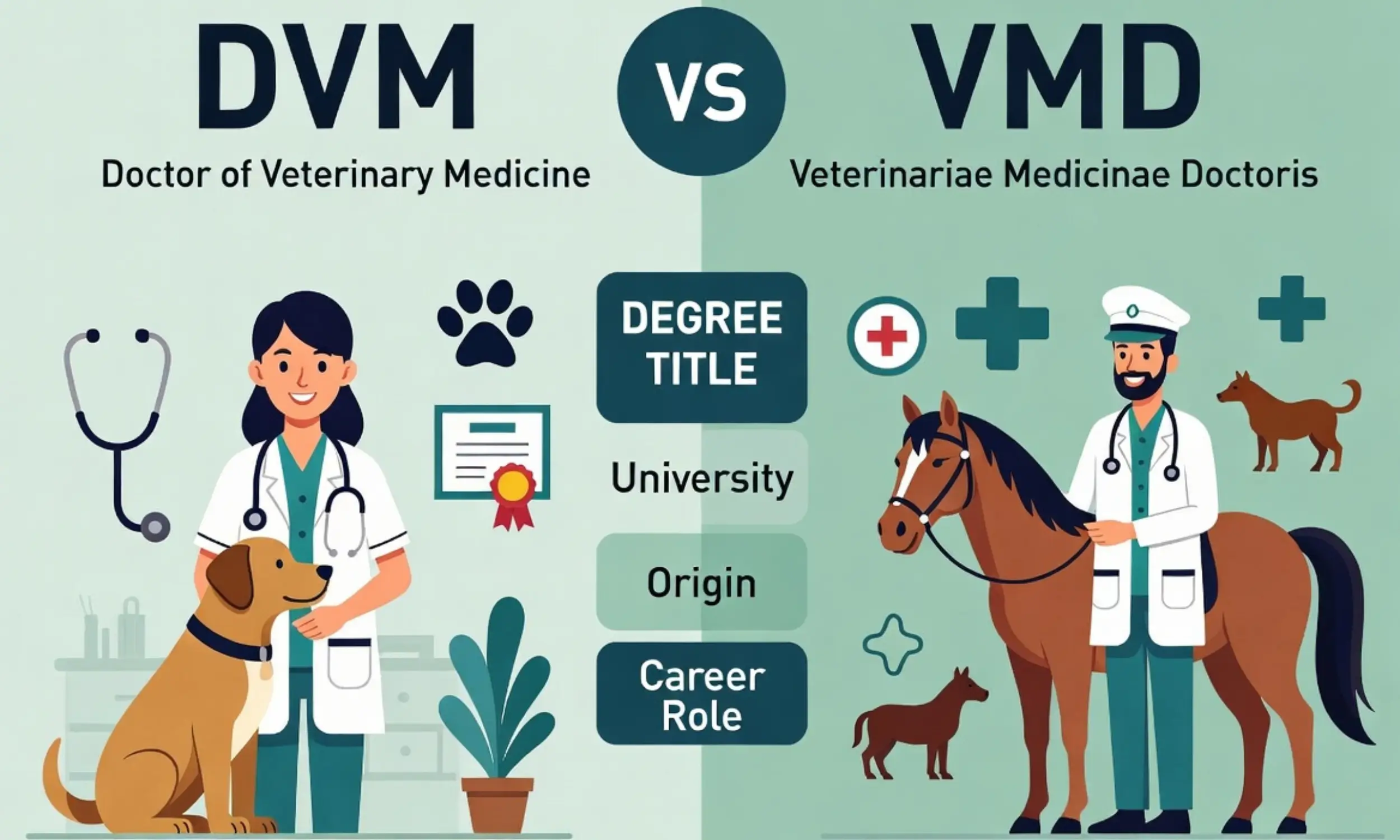
The main difference is the degree title and historical origin.
- DVM (Doctor of Veterinary Medicine) is the most common veterinary degree used worldwide.
- VMD (Veterinariae Medicinae Doctoris) is a Latin title used only by one university in the United States.
Both degrees qualify a person to become a licensed veterinarian.
Why Their Difference Is Important for Learners and Experts
Understanding the difference between DVM and VMD helps students planning veterinary careers. Many aspiring veterinarians worry that one degree might be stronger than the other. In reality, both degrees provide the same training and authority to practice veterinary medicine.
For experts and society, knowing this difference prevents misinformation. Pet owners, farmers, and animal organizations can confidently trust veterinarians regardless of whether they hold a DVM or VMD degree. This knowledge also helps educational institutions explain veterinary credentials clearly.
Pronunciation (US & UK)
DVM
- US: dee-vee-em
- UK: dee-vee-em
VMD
- US: vee-em-dee
- UK: vee-em-dee
Now that we understand the basics, let us explore the detailed difference between DVM and VMD.
Difference Between DVM and VMD
1. Degree Name
DVM stands for Doctor of Veterinary Medicine.
VMD stands for Veterinariae Medicinae Doctoris.
Examples:
- A veterinarian graduating from many universities receives a DVM.
- A graduate from the University of Pennsylvania receives a VMD.
2. Historical Origin
DVM was adopted by most veterinary schools worldwide.
VMD comes from a Latin naming tradition.
Examples:
- Most U.S. veterinary schools award DVM.
- The University of Pennsylvania uses the VMD title.
3. Universities Offering the Degree
DVM is offered by hundreds of veterinary schools globally.
VMD is offered by only one university.
Examples:
- Cornell University offers a DVM program.
- The University of Pennsylvania awards VMD degrees.
4. Language of the Degree
DVM uses English terminology.
VMD uses Latin words.
Examples:
- “Doctor of Veterinary Medicine” is written in English.
- “Veterinariae Medicinae Doctoris” is Latin.
5. Global Recognition
Both degrees are internationally recognized.
Examples:
- A DVM holder can practice in many countries.
- A VMD holder can also practice internationally.
6. Professional Role
Both professionals treat animals, diagnose diseases, and perform surgeries.
Examples:
- A DVM veterinarian treats farm animals.
- A VMD veterinarian performs pet surgeries.
7. Educational Curriculum
The curriculum for both degrees is almost identical.
Examples:
- Students learn anatomy and animal physiology.
- They also study surgery and veterinary medicine.
8. Licensing Requirement
Both degrees require passing licensing exams.
Examples:
- A DVM graduate must pass veterinary licensing exams.
- A VMD graduate must also pass the same exams.
9. Career Opportunities
Both degrees lead to similar careers.
Examples:
- A DVM graduate may work in animal hospitals.
- A VMD graduate may work in research or wildlife care.
10. Professional Status
Both degrees hold equal professional respect.
Examples:
- Pet owners trust DVM veterinarians.
- Farmers rely on VMD veterinarians for livestock care.
Nature and Behaviour of Both
DVM
Represents the modern and widely adopted veterinary degree. It emphasizes practical veterinary science and global professional standards.
VMD
Represents a traditional academic naming style rooted in Latin. It reflects historical academic traditions in veterinary education.
Why People Are Confused About Their Use
Many people think DVM and VMD represent different levels of expertise. The confusion arises because the titles look different. However, both degrees prepare veterinarians with the same medical training and authority to treat animals.
Table Showing Difference and Similarity
| Aspect | DVM | VMD | Similarity |
| Full Form | Doctor of Veterinary Medicine | Veterinariae Medicinae Doctoris | Both are veterinary degrees |
| Language | English | Latin | Both mean the same |
| Universities | Many worldwide | One university | Both accredited |
| Career | Veterinary medicine | Veterinary medicine | Same profession |
| Recognition | Global | Global | Equal status |
Which Is Better in What Situation?
DVM
The DVM degree is more common worldwide. Students often prefer it because it is widely recognized and offered by many veterinary schools. It is ideal for students seeking flexible study options and international career opportunities. A DVM graduate can work in animal clinics, research centers, farms, or government veterinary services. Since most universities offer this program, students can easily find programs that suit their academic goals.
VMD
The VMD degree is unique and prestigious because it is awarded by a specific university with a long academic tradition. Students who study there receive the same veterinary training but with a Latin degree title. The VMD degree may appeal to students who appreciate historical academic traditions and the reputation of that institution. However, in practice, VMD graduates work in the same veterinary roles as DVM graduates.
Metaphors and Similes
- “A DVM and VMD are like two labels on the same medicine bottle.”
- “Choosing between them is like choosing tea or coffee mugs for the same drink.”
Connotative Meaning
DVM
Neutral to positive.
Example: “She proudly earned her DVM and started helping injured animals.”
VMD
Neutral and academic.
Example: “The VMD title reflects a long-standing university tradition.”
Idioms or Proverbs Related
“Don’t judge a book by its cover.”
Example: The difference between DVM and VMD shows why we should not judge a professional only by the title.
“Actions speak louder than words.”
Example: Whether DVM or VMD, the veterinarian’s skill matters most.
Works in Literature Mentioning Veterinary Medicine
- All Creatures Great and Small — Memoir, James Herriot, 1972
- The Call of the Wild — Adventure, Jack London, 1903
Movies Related to Veterinary or Animal Care
- Dr. Dolittle — 1998, USA
- All Creatures Great and Small — 1975, UK
Frequently Asked Questions
1. Is DVM better than VMD?
No. Both degrees are equal in training and professional recognition.
2. Why does only one university use VMD?
It follows a traditional Latin naming style.
3. Can VMD holders work as veterinarians?
Yes. They have the same qualifications as DVM graduates.
4. Do both require licensing exams?
Yes. Both must pass veterinary licensing exams.
5. Which degree is more common?
DVM is more common worldwide.
How Both Are Useful for Surroundings
Veterinarians with DVM or VMD degrees protect animal health, improve livestock productivity, and ensure food safety. They also help control diseases that may spread from animals to humans. Their work supports farmers, pet owners, and wildlife conservation.
Final Words for Both
DVM and VMD represent two names for the same respected profession. Both degrees train experts who dedicate their lives to caring for animals and protecting public health.
Conclusion
The difference between DVM and VMD is mainly about the degree title rather than the professional training. DVM stands for Doctor of Veterinary Medicine and is used by most veterinary schools worldwide.
VMD, on the other hand, is a Latin form used by a single institution with a strong academic tradition. Despite the different names, both degrees provide the same education, skills, and career opportunities.
Veterinarians with either degree diagnose illnesses, perform surgeries, and promote animal welfare.
Understanding this difference helps students choose veterinary programs wisely and helps society appreciate the valuable work of veterinary professionals.