Imagine a student preparing for exams. He says, “I feel mentally tired,” but later tells a friend, “I’m facing psychological stress.” At first, both sound similar. But are they really the same? This is where the difference between mental and psychological becomes important.
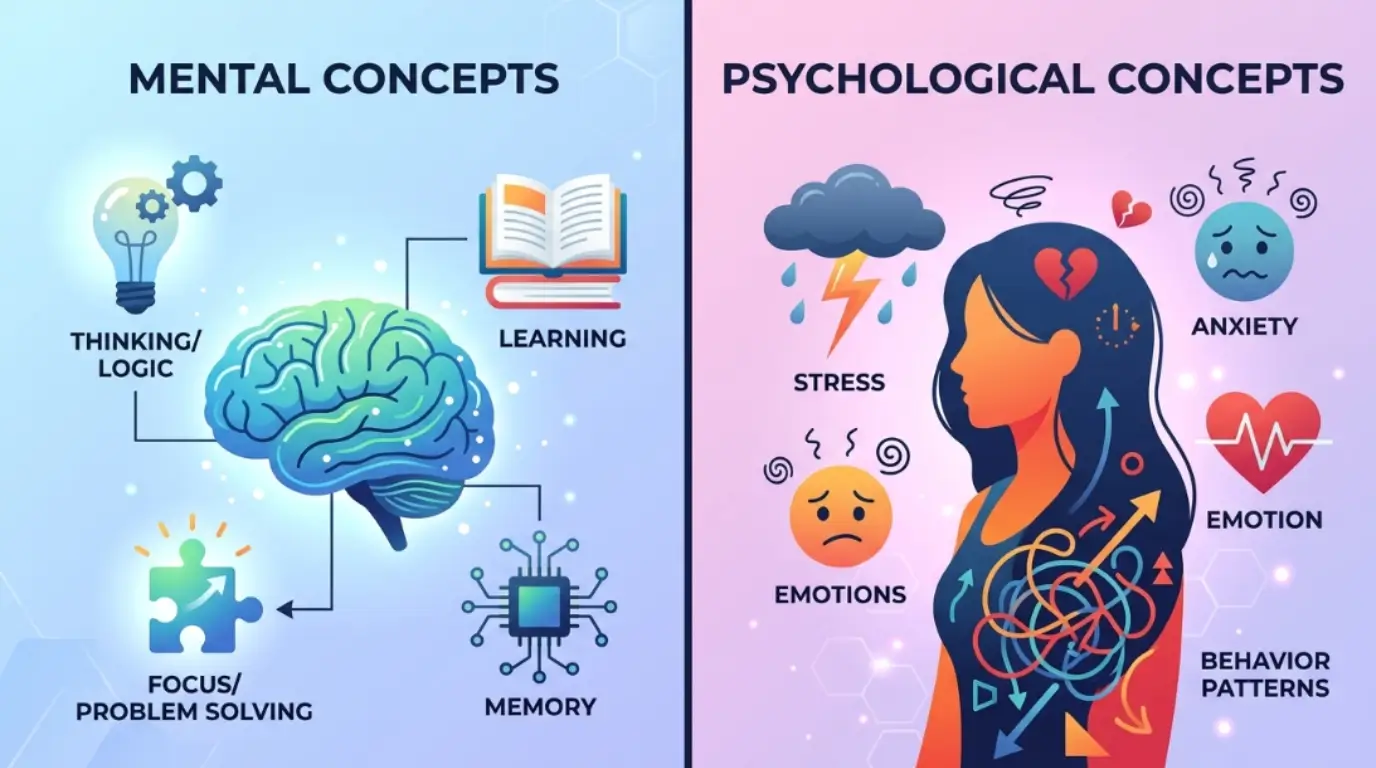
The word mental relates to the mind’s basic functions like thinking, memory, and focus. On the other hand, psychological goes deeper into emotions, behavior, and how the mind reacts to situations.
Many people mix them up, but understanding the difference between mental and psychological helps in better communication and awareness.
In daily life, we often use these terms without thinking. However, knowing the difference between mental and psychological can improve how we understand ourselves and others. So let’s break it down in the simplest way possible.
Key Difference Between Mental and Psychological
The main difference between mental and psychological is depth and scope.
- Mental focuses on basic brain activities like thinking, remembering, and concentration.
- Psychological deals with emotions, behavior, personality, and deeper mental processes.
Why Is It Important to Know the Difference?
Understanding the difference between mental and psychological is useful for both learners and professionals. It helps in education, healthcare, and even daily conversations. For example, a teacher may address mental focus issues, while a psychologist deals with emotional or behavioral problems.
In society, this knowledge improves awareness about mental health. It helps people seek the right support—whether they need simple rest or professional therapy. For experts, it creates clarity in diagnosis and treatment.
Pronunciation (US & UK)
- Mental
- US: /ˈmen.t̬əl/
- UK: /ˈmen.təl/
- Psychological
- US: /ˌsaɪ.kəˈlɑː.dʒɪ.kəl/
- UK: /ˌsaɪ.kəˈlɒdʒ.ɪ.kəl/
Now that you know the basics, let’s dive deeper into the detailed comparison.
Difference Between Mental and Psychological (10 Points Explained)
1. Meaning
- Mental: Related to the mind’s basic functions
- Example 1: She has strong mental focus during exams
- Example 2: Mental math improves brain speed
- Psychological: Related to emotions and behavior
- Example 1: He is under psychological pressure
- Example 2: Therapy helps psychological healing
2. Scope
- Mental: Narrow scope (thinking, memory)
- Example 1: Mental exercise improves memory
- Example 2: Mental fatigue affects concentration
- Psychological: Broad scope (behavior, emotions)
- Example 1: Psychological studies explore behavior
- Example 2: Stress affects psychological health
3. Usage
- Mental: Used in everyday simple context
- Example 1: Mental strength is important
- Example 2: Mental clarity helps decisions
- Psychological: Used in academic/professional context
- Example 1: Psychological research is complex
- Example 2: Psychological tests measure personality
4. Focus
- Mental: Focus on thinking ability
- Example 1: Mental alertness is needed
- Example 2: Mental skills improve learning
- Psychological: Focus on emotions and reactions
- Example 1: Psychological fear affects actions
- Example 2: Psychological trauma needs care
5. Field
- Mental: General use
- Example 1: Mental health awareness
- Example 2: Mental exercises daily
- Psychological: Scientific field (psychology)
- Example 1: Psychological theories
- Example 2: Psychological counseling
6. Depth
- Mental: Surface-level processes
- Example 1: Mental calculation
- Example 2: Mental focus
- Psychological: Deep inner processes
- Example 1: Psychological analysis
- Example 2: Psychological patterns
7. Relation
- Mental: Brain function
- Example 1: Mental alertness
- Example 2: Mental sharpness
- Psychological: Mind + emotions + behavior
- Example 1: Psychological balance
- Example 2: Psychological growth
8. Problems
- Mental: Simple issues like tiredness
- Example 1: Mental exhaustion
- Example 2: Mental block
- Psychological: Complex issues
- Example 1: Psychological disorders
- Example 2: Psychological trauma
9. Treatment
- Mental: Rest, exercise, routine
- Example 1: Sleep improves mental health
- Example 2: Breaks reduce mental stress
- Psychological: Therapy, counseling
- Example 1: Psychological therapy
- Example 2: Counseling sessions
10. Application
- Mental: Daily tasks
- Example 1: Mental planning
- Example 2: Mental preparation
- Psychological: Research & behavior understanding
- Example 1: Psychological experiments
- Example 2: Behavioral studies
Nature and Behavior
- Mental: Simple, direct, and practical. It deals with thinking and awareness.
- Psychological: Complex and deep. It explores emotions, personality, and reactions.
Why People Get Confused
People confuse these terms because both relate to the mind. In casual speech, “mental” is often used instead of “psychological.” Also, both are connected, which makes the difference between mental and psychological less obvious.
Difference and Similarity Table
| Aspect | Mental | Psychological |
| Meaning | Basic mind function | Study of mind & behavior |
| Scope | Narrow | Broad |
| Use | Daily language | Academic/professional |
| Focus | Thinking | Emotions & behavior |
| Similarity | Both relate to the human mind |
Which Is Better in What Situation?
Use mental when talking about simple brain functions like focus, memory, or tiredness. For example, “mental strength” or “mental fatigue” fits daily conversation.
Use psychological when discussing deeper emotional or behavioral issues. For example, therapy, trauma, or personality studies require this term. It is more suitable in professional or academic situations.
Metaphors and Similes
- Mental: “His mind is a sharp knife”
- Psychological: “Her emotions are like a storm”
Connotative Meaning
- Mental → Neutral (can be positive or negative)
- Positive: Mental strength
- Negative: Mental stress
- Psychological → Often serious/negative but also neutral
- Example: Psychological disorder (negative)
- Example: Psychological study (neutral)
Idioms & Proverbs
- “Mind over matter” (Mental strength)
- “As you think, so you become” (Mental & psychological link)
Works in Literature
- Psychology and Life – Richard Gerrig (Psychology, 2013)
- Thinking, Fast and Slow – Daniel Kahneman (Cognitive, 2011)
- Man’s Search for Meaning – Viktor Frankl (Psychological, 1946)
Movies Related to the Concepts
- A Beautiful Mind (2001, USA)
- Black Swan (2010, USA)
- Joker (2019, USA)
FAQs
1. Are mental and psychological the same?
No, mental is basic thinking, while psychological is deeper emotional and behavioral study.
2. Which term is more scientific?
Psychological is more scientific and used in research.
3. Can mental issues become psychological?
Yes, prolonged mental stress can lead to psychological problems.
4. Which word should I use daily?
Use mental for simple situations and psychological for deeper discussions.
5. Why is the difference important?
It helps in better understanding and correct communication.
How Both Are Useful in Our Surroundings
Both terms play a key role in daily life. Mental strength helps us handle routine tasks, while psychological understanding improves relationships and emotional health. Together, they create balance in personal and social life.
Conclusion
The difference between mental and psychological may seem small, but it is very important. Mental relates to basic thinking and brain function, while psychological explores deeper emotions and behavior. Knowing this difference helps in communication, education, and mental health awareness.
In simple words, mental is about how we think, and psychological is about why we think and feel that way. Understanding both makes us more aware and better prepared to handle life’s challenges.