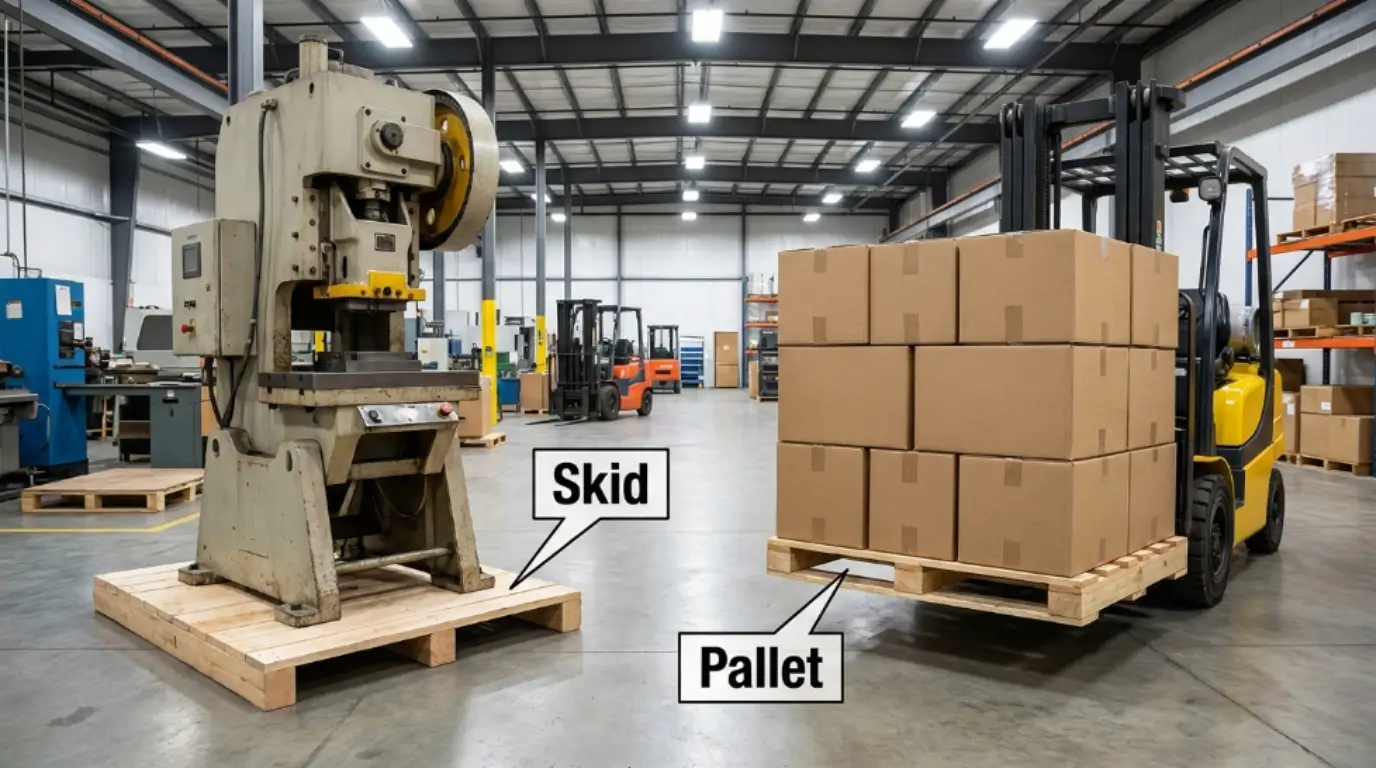
Imagine a busy warehouse where workers move heavy boxes from one truck to another. Some goods are placed on a skid, while others are stacked on a pallet.
At first glance, both look almost the same, so many people think they are identical. However, the difference between skid and pallet becomes very important in shipping, storage, factories, and transportation.
Understanding the difference between skid and pallet helps workers avoid damage, improve safety, and save money.
In logistics and manufacturing, the difference between skid and pallet also affects how goods are lifted and stored.
Many beginners often confuse these two platforms because they are both used for carrying materials.
Still, the difference between skid and pallet is clear once you understand their structure, purpose, and usage in real-life situations.
Before moving deeper into the topic, let us first learn how these words are pronounced and connected in daily communication.
Pronunciation of Skid and Pallet
Skid
- US Pronunciation: /skɪd/
- UK Pronunciation: /skɪd/
Pallet
- US Pronunciation: /ˈpæl.ɪt/
- UK Pronunciation: /ˈpæl.ɪt/
These words sound simple, but their meanings create a major difference in industries and transportation systems around the world.
Key Difference Between Skid and Pallet
The main difference is that a skid has a single deck and usually rests directly on the ground, while a pallet has both a top and bottom deck, making it easier to lift using forklifts from different sides.
A skid is often used as a permanent base for machinery or equipment. In contrast, a pallet is mainly designed for transporting and storing products safely.
Why Is Their Difference Important for Learners and Experts?
Knowing the difference between skid and pallet is important because both are widely used in factories, warehouses, shipping companies, and retail stores. Students learning supply chain management need this knowledge to understand logistics properly. Workers and experts use this information to improve safety and efficiency during transportation.
In society, pallets help businesses move goods quickly, while skids support heavy machinery and industrial equipment. Confusing them may lead to incorrect handling, product damage, or financial loss. Therefore, understanding their separate roles benefits industries, workers, and consumers alike.
Difference Between Skid and Pallet
1. Structure
Skid
A skid has no bottom deck. It rests directly on the ground.
Examples:
- A factory machine placed on a wooden skid.
- Heavy engines stored on steel skids.
Pallet
A pallet has both top and bottom decks for support.
Examples:
- Grocery items stacked on pallets.
- Boxes moved in warehouses using pallets.
2. Mobility
Skid
Skids are harder to move because they slide on the ground.
Examples:
- A skid dragged across a workshop floor.
- Construction equipment moved on skids.
Pallet
Pallets are easier to lift with forklifts and pallet jacks.
Examples:
- A forklift lifting a loaded pallet.
- Retail goods shifted using pallets.
3. Main Purpose
Skid
Skids mainly support heavy machinery or permanent equipment.
Examples:
- Printing machines mounted on skids.
- Industrial pumps attached to skids.
Pallet
Pallets mainly transport and store products.
Examples:
- Food products stored on pallets.
- Electronics shipped on pallets.
4. Weight Handling
Skid
Skids are better for extremely heavy loads.
Examples:
- Large generators on skids.
- Metal equipment fixed on skids.
Pallet
Pallets handle moderate to heavy commercial goods.
Examples:
- Beverage boxes on pallets.
- Furniture loaded on pallets.
5. Forklift Access
Skid
A skid offers limited forklift access.
Examples:
- Workers lifting one side only.
- Machines requiring careful lifting.
Pallet
Pallets allow easier multi-side access.
Examples:
- Forklifts lifting from four directions.
- Warehouse workers quickly moving stock.
6. Usage Area
Skid
Skids are common in industrial settings.
Examples:
- Oil and gas equipment on skids.
- Factory generators on skids.
Pallet
Pallets are common in warehouses and retail businesses.
Examples:
- Supermarket storage pallets.
- Shipping center pallet systems.
7. Design Complexity
Skid
Skids have a simpler design.
Examples:
- Flat wooden skid frames.
- Basic steel skid bases.
Pallet
Pallets are designed for better balance and handling.
Examples:
- Double-deck wooden pallets.
- Plastic shipping pallets.
8. Durability
Skid
Skids are often stronger for rough conditions.
Examples:
- Outdoor industrial skids.
- Heavy-duty construction skids.
Pallet
Pallets focus on transport convenience.
Examples:
- Disposable export pallets.
- Lightweight warehouse pallets.
9. Cost
Skid
Skids are usually cheaper because of simpler construction.
Examples:
- Basic wooden skids.
- Reusable steel skids.
Pallet
Pallets may cost more due to extra support.
Examples:
- Heat-treated export pallets.
- Heavy-duty plastic pallets.
10. Reusability
Skid
Skids are often reused for long-term industrial purposes.
Examples:
- Permanent machine bases.
- Factory equipment support systems.
Pallet
Pallets are reused mainly for shipping cycles.
Examples:
- Retail delivery pallets.
- Warehouse return pallets.
Nature and Behaviour of Both
A skid behaves like a strong stationary base. It is designed more for stability and support than for transportation. Its nature is rugged and industrial.
A pallet behaves like a movable transport platform. It supports quick loading, unloading, and storage. Its nature is flexible and transport-friendly.
People are confused because both are flat structures made from wood, steel, or plastic. They also carry heavy items and are used in warehouses. Their similar appearance makes many people use the terms interchangeably.
Difference and Similarity Table
| Feature | Skid | Pallet | Similarity |
| Bottom Deck | No | Yes | Both support goods |
| Main Purpose | Support machinery | Transport products | Used in industries |
| Mobility | Limited | Easy | Carry heavy loads |
| Forklift Access | Restricted | Flexible | Used with forklifts |
| Design | Simple | Advanced | Made from wood/plastic/steel |
| Usage | Industrial equipment | Warehouses and shipping | Improve organization |
| Durability | Heavy-duty | Transport-focused | Reusable |
| Cost | Usually lower | Usually higher | Save labor time |
Which Is Better in Different Situations?
A skid is better when heavy industrial machinery needs stable support for long periods. Factories, workshops, and construction sites often prefer skids because they are strong and simple. They also work well for dragging equipment short distances.
A pallet is better for shipping, storage, and warehouse operations. Businesses prefer pallets because forklifts can move them quickly and safely. Pallets are ideal for retail products, export goods, and organized inventory systems.
Metaphors and Similes
Skid
- “His career hit a skid.”
Meaning: His progress suddenly declined. - “The old truck moved like a skid across ice.”
Meaning: It moved roughly and without control.
Pallet
- “The warehouse was organized like stacked pallets.”
Meaning: Everything was neatly arranged. - “Her responsibilities piled up like loaded pallets.”
Meaning: Tasks increased heavily.
Connotative Meaning
Skid
- Positive: Strong, stable, rugged.
- Negative: Rough, outdated, difficult to move.
- Neutral: Industrial support platform.
Examples:
- Positive: “The skid held the machine securely.”
- Negative: “The project went into a skid.”
- Neutral: “Workers placed the engine on a skid.”
Pallet
- Positive: Organized, efficient, modern.
- Negative: Heavy, bulky.
- Neutral: Transport platform.
Examples:
- Positive: “The pallet system improved warehouse speed.”
- Negative: “The broken pallet caused delays.”
- Neutral: “Goods arrived on wooden pallets.”
Idioms or Related Expressions
Related to Skid
- “Hit the skids”
Meaning: To decline or fail financially.
Example:
“The company hit the skids after losing customers.”
Related to Pallet
There are no famous English idioms directly connected to “pallet,” but the word is commonly used in logistics phrases.
Example:
“The workers palletized the boxes before shipping.”
Works in Literature
Skid
- Skid — Poetry Collection by Patrick Phillips (Poetry, 2015)
- Skid Road by Josephine Ensign (Nonfiction, 2021)
Pallet
- The Pallet Maker by Mark Powell (Fiction, 2010)
Movies Related to the Keywords
Skid
- Skid Marks (2007, USA)
- Skid (1993, Canada)
Pallet
Direct movie titles using “Pallet” are uncommon, but the term often appears in industrial and logistics documentaries.
Frequently Asked Questions
1. What is the main difference between skid and pallet?
A skid has no bottom deck, while a pallet has both top and bottom decks.
2. Which is easier to move?
A pallet is easier to move because forklifts can lift it from multiple sides.
3. Why are skids used for machinery?
Skids provide strong and stable support for heavy industrial equipment.
4. Are pallets more common in warehouses?
Yes, pallets are widely used in warehouses for shipping and storage.
5. Can both be made from plastic or steel?
Yes, skids and pallets can both be made from wood, plastic, or metal.
How Both Are Useful for Surroundings
Skids and pallets improve transportation, organization, and workplace safety. They help industries move heavy goods efficiently while reducing physical labor. Pallets keep warehouses organized and speed up deliveries. Skids protect heavy machinery and reduce damage during handling. Together, they support global trade and industrial growth.
Conclusion
The difference between skid and pallet may seem small at first, but it plays a major role in logistics and industrial work.
A skid is mainly designed for stability and supporting heavy equipment, while a pallet is built for efficient transportation and storage.
Both tools are important in warehouses, factories, and shipping industries. Understanding their structure, purpose, and behavior helps learners, workers, and businesses make better decisions.
Although many people use these words interchangeably, knowing the correct term improves communication and professional knowledge.
In the modern world of trade and transportation, both skids and pallets continue to support industries and make material handling easier, safer, and more organized.