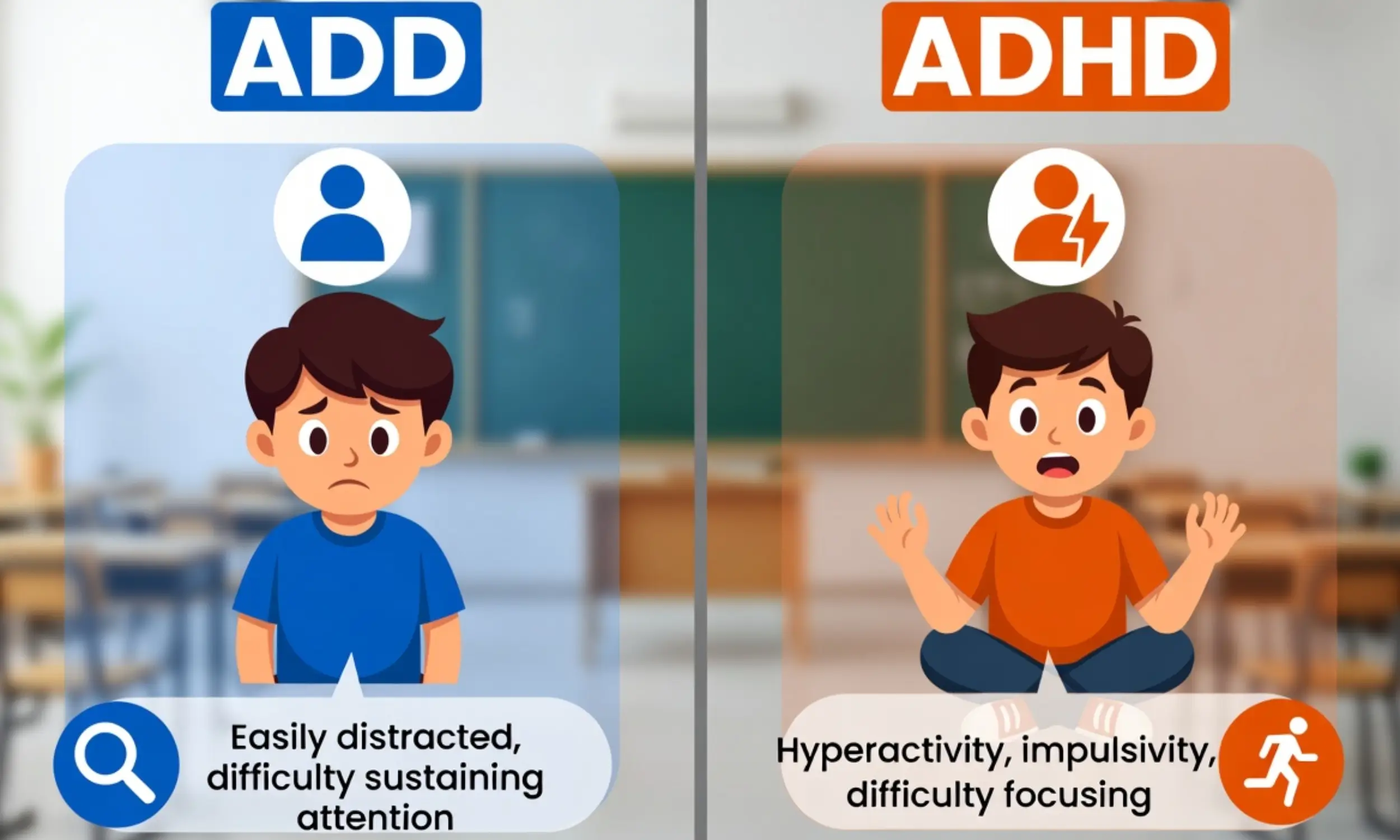
Imagine Sarah, a brilliant graphic designer who constantly misses deadlines because she gets “lost” in her own thoughts. She isn’t disruptive; she’s just… elsewhere.
Now, compare her to Leo, a whirlwind of energy who can’t sit through a ten-minute meeting without tapping his pen or pacing. For years, people used the term ADD to describe Sarah and ADHD for Leo.
However, the difference between ADD ADHD isn’t just about who is louder; it’s about how their brains process the world. Understanding the difference between ADD ADHD helps us move past labels of “lazy” or “difficult.”
As we dive into the difference between ADD ADHD, we realize that these aren’t two separate disorders, but different expressions of the same neurological trait.
Key Difference Between the Both
Technically, ADD (Attention Deficit Disorder) is an outdated medical term. Today, it is officially considered a subtype of ADHD (Attention-Deficit/Hyperactivity Disorder). The primary difference lies in the presence of physical hyperactivity. ADD is “ADHD without the H.”
Why the Difference is Necessary for Learners and Experts
In a society that values productivity, knowing the difference between ADD ADHD is vital. For educators, it prevents “quiet” students from slipping through the cracks. For medical experts, it ensures that a child isn’t misdiagnosed simply because they aren’t jumping off the walls. Accurate identification fosters a more inclusive society where neurodivergent individuals are supported rather than sidelined.
Pronunciation Guide
- ADD: * US/UK: /ˌeɪ.diːˈdiː/ (A-D-D)
- ADHD: * US/UK: /ˌeɪ.diː.eɪtʃˈdiː/ (A-D-H-D)
Now that we’ve cleared the air on the terminology, let’s peel back the layers and look at how these two manifest in daily life.
The 10 Essential Differences Between ADD and ADHD
1. Physical Activity Levels
The most obvious indicator is movement. ADHD involves high energy, while ADD is characterized by physical stillness.
- Example 1: An ADHD student might stand up during a lecture.
- Example 2: An ADD student will sit perfectly still but may be doodling on every page.
2. Concentration Styles
Both struggle with focus, but in different ways. ADD is a “fog,” while ADHD is a “storm.”
- Example 1: A person with ADD might forget the beginning of a sentence while someone is speaking.
- Example 2: A person with ADHD might get distracted by a bird outside and lose their train of thought.
3. Impulsivity
ADHD usually includes a “no-filter” reaction, whereas ADD involves more internal processing.
- Example 1: ADHD: Blabbing out an answer before the teacher finishes the question.
- Example 2: ADD: Agreeing to a task without realizing they don’t have time for it.
4. Visibility of Symptoms
ADHD is “externalized,” making it easier to spot. ADD is “internalized,” making it easy to miss.
- Example 1: A parent notices their ADHD child can’t stay in their seat at dinner.
- Example 2: A teacher might think an ADD student is just “dreamy” or shy.
5. Social Interaction
The way they navigate conversations differs based on energy levels.
- Example 1: Someone with ADHD might frequently interrupt others.
- Example 2: Someone with ADD might drift off and lose the thread of the conversation.
6. Organization Skills
Both struggle here, but the results look different.
- Example 1: ADHD: A messy desk with papers scattered everywhere.
- Example 2: ADD: A clean-looking desk where the person has no idea where they put their keys.
7. Noise Levels
ADHD is often associated with being “loud,” while ADD is associated with being “quiet.”
- Example 1: An ADHD child hums or makes sound effects while playing.
- Example 2: An ADD child plays silently for hours.
8. Speed of Completion
One rushes; the other lingers.
- Example 1: An ADHD worker rushes through a report and makes “careless” typos.
- Example 2: An ADD worker takes three hours to start the report because they are staring at the blank screen.
9. Sensory Processing
How they react to the environment varies.
- Example 1: ADHD: Becomes agitated in a loud, crowded room.
- Example 2: ADD: Becomes overwhelmed and “shuts down” in a loud room.
10. Risk-Taking
One seeks thrills; the other avoids the effort.
- Example 1: ADHD: Jumping off a high ledge on a whim.
- Example 2: ADD: Missing an opportunity because they were too distracted to notice it.
Nature and Behavior
- ADHD (Hyperactive-Impulsive): This behavior is characterized by a “driven by a motor” feeling. The nature is proactive, energetic, and often creative but disorganized.
- ADD (Inattentive): This behavior is more passive. The nature is reflective, imaginative, and “spacey.” These individuals are often deep thinkers but struggle with “executive function” (getting started).
Why People are Confused
The confusion exists because “ADD” was the official name in the 1980s. In 1987, it was changed to “ADHD” in medical manuals. Most people still use ADD as a shorthand for the quiet version, even though the doctor’s note will say “ADHD-Inattentive Type.”
Comparison Table: ADD vs. ADHD
| Feature | ADD (Inattentive) | ADHD (Hyperactive/Combined) |
| Primary Symptom | Forgetfulness / Distraction | Hyperactivity / Impulsivity |
| Visible Energy | Low to Moderate | High / Restless |
| Social Style | Withdrawn / Daydreaming | Talkative / Interrupting |
| Common Misconception | Lazy or Uninterested | Badly behaved or Aggressive |
| Similarity | Both involve Dopamine regulation | Both involve Dopamine regulation |
| Similarity | Both benefit from structure | Both benefit from structure |
Which is Better in What Situation?
ADHD shines in high-pressure, fast-paced environments. In an emergency or a high-energy sales floor, the ability to jump from task to task and the “hyperfocus” on a crisis can be a superpower. Their energy can be infectious and motivating for a team.
ADD is often better suited for creative, deep-work roles. Because their “hyperactivity” is internal, they can spend hours in imaginative worlds. They excel in solo research, art, or programming where being “lost in thought” is actually a requirement for breakthrough ideas.
Metaphors and Similes
- Simile (ADHD): “His mind is like a pinball machine, constantly bouncing between ideas.”
- Metaphor (ADD): “She is a radio tuned between two stations, catching bits of music through the static.”
Connotative Meanings
- ADD: Often carries a Neutral to Negative connotation, implying someone is “not all there” or “flaky.” Example: “Stop being so ADD and listen to me.”
- ADHD: Often carries a Negative connotation of being “uncontrollable,” though it is shifting toward a Positive connotation of high energy/creativity. Example: “His ADHD energy makes him a great performer.”
Idioms and Proverbs
- “Scatterbrained” (ADD): She’s so scatterbrained she’d forget her head if it wasn’t attached.
- “Bounce off the walls” (ADHD): The kids have been inside all day and are bouncing off the walls.
- “A mile a minute” (ADHD): He talks a mile a minute when he’s excited.
Literature, Books, and Movies
- Literature:
- Percy Jackson & The Olympians (Fantasy) – Rick Riordan (2005): Features protagonists with ADHD.
- Driven to Distraction (Non-Fiction) – Edward Hallowell (1994): The definitive book on the subject.
- Movies:
- Everything Everywhere All At Once (Sci-Fi/Drama) – 2022, USA: A cinematic metaphor for the ADHD experience.
- The Perks of Being a Wallflower (Drama) – 2012, USA: Touches on the “quiet” inattentiveness of ADD/trauma.
Frequently Asked Questions (FAQ)
- Can you have both? Yes, this is called “Combined Type ADHD.”
- Does ADD go away? No, but people learn coping mechanisms as they age.
- Is it just for kids? Absolutely not; millions of adults are diagnosed later in life.
- Is medication the only cure? There is no “cure,” but therapy, exercise, and diet help alongside medication.
- Is it a learning disability? No, it’s a self-regulation disorder, though it can impact learning.
How Both are Useful for Surroundings
Neurodiversity makes the world better. ADHD individuals bring innovation and urgency to projects, while those with ADD bring nuance and deep imagination. A team with both types is often more balanced than a “neurotypical” one.
Conclusion
The difference between ADD ADHD is ultimately a matter of how energy is expressed inwardly or outwardly.
While the medical world has moved toward the umbrella term “ADHD,” the lived experiences of those who are “dreamers” (ADD) versus those who are “doers” (ADHD) remain distinct.
In conclusion, understanding these nuances allows us to stop judging people for how their brains are wired.
Whether it’s the quiet distraction of ADD or the vibrant impulsivity of ADHD, these traits are part of the human spectrum. By recognizing the strengths in both, we can build environments at home, school, and work where everyone has the chance to thrive.