Imagine you run a big apartment building. One day, you decide to divide it into fully separate homes, each with its own kitchen, walls, and rules. That is like virtualization. Another day, you create shared living spaces where people use the same structure but keep their own rooms. That is containerization.
The difference between virtualization and containerization matters a lot in today’s tech world. Many beginners struggle to understand the difference between virtualization and containerization, while experts use it daily to build apps faster.
In simple terms, virtualization creates full virtual machines, while containerization shares the system to run lightweight apps. Knowing the difference between virtualization and containerization helps you choose the right technology.
This difference between virtualization and containerization also saves time, cost, and resources in real-world projects.
Key Difference Between the Both
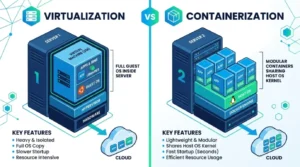
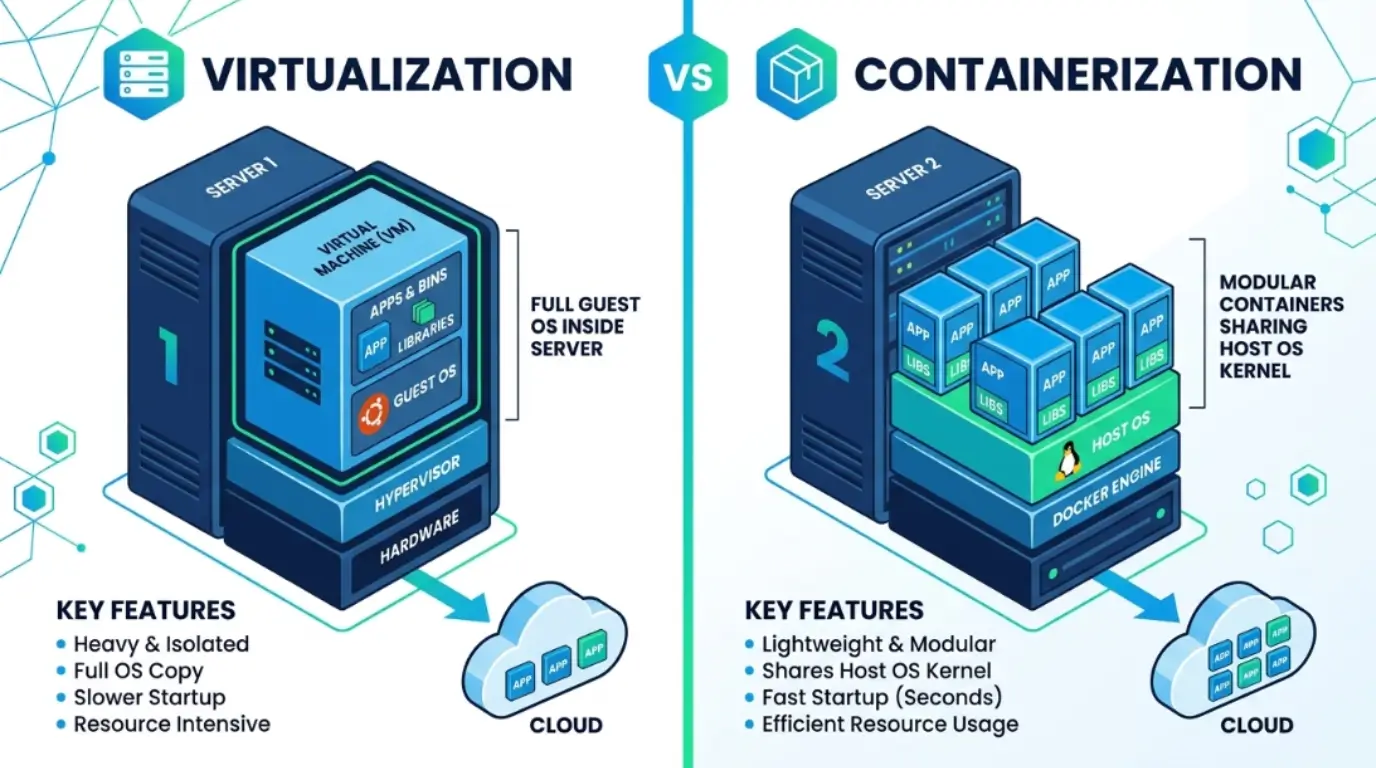
Virtualization creates complete virtual systems with their own OS. Containerization runs apps using the same OS but in isolated spaces.
Why Is Their Difference Important?
Understanding the difference between virtualization and containerization helps learners build strong tech basics. For experts, it improves performance, reduces cost, and speeds up development. In society, it powers cloud computing, apps, and modern digital services.
Pronunciation
- Virtualization (US): vur-choo-uh-luh-ZAY-shun
- Virtualization (UK): vuh-choo-uh-lai-ZAY-shun
- Containerization (US): kuhn-TAY-nuh-ruh-ZAY-shun
- Containerization (UK): kuhn-TAY-nuh-rai-ZAY-shun
Now that you understand the basics, let’s explore their differences in detail.
Difference Between Virtualization and Containerization
1. System Structure
Virtualization creates full virtual machines. Containerization creates lightweight containers.
Examples:
- Virtualization: Running Windows on Linux
- Containerization: Running apps in Docker
2. Resource Usage
Virtual machines use more memory and CPU. Containers use fewer resources.
Examples:
- VM: Needs full OS memory
- Container: Shares host OS
3. Speed
Virtual machines are slower to start. Containers start instantly.
Examples:
- VM: Takes minutes
- Container: Takes seconds
4. Isolation Level
VMs offer strong isolation. Containers offer process-level isolation.
Examples:
- VM: Fully separate system
- Container: Shared kernel
5. Operating System
VMs run different OS types. Containers use the same OS.
Examples:
- VM: Linux + Windows
- Container: Same Linux kernel
6. Portability
Containers are highly portable. VMs are less portable.
Examples:
- Container: Runs anywhere
- VM: Needs setup
7. Storage Size
VMs are large in size. Containers are small.
Examples:
- VM: GBs in size
- Container: MBs in size
8. Performance
VMs have slower performance. Containers are faster.
Examples:
- VM: More overhead
- Container: Lightweight
9. Use Cases
VMs are used for full systems. Containers are for apps.
Examples:
- VM: Testing OS
- Container: Microservices
10. Management
VMs are complex to manage. Containers are simple.
Examples:
- VM: Needs hypervisor
- Container: Managed via tools like Docker
Nature and Behaviour
Virtualization behaves like a complete system with strong separation. It is stable but heavy.
Containerization behaves like a shared environment. It is fast, flexible, and lightweight.
Why People Are Confused
People confuse them because both create isolated environments. The main confusion comes from thinking they do the same job, but their structure and purpose are different.
Table: Difference and Similarity
| Feature | Virtualization | Containerization | Similarity |
| Structure | Full OS | Shared OS | Both isolate apps |
| Speed | Slow | Fast | Improve efficiency |
| Size | Large | Small | Used in cloud |
| Isolation | Strong | Moderate | Secure apps |
| Usage | System-level | App-level | Modern tech tools |
Which Is Better in What Situation?
Virtualization is better when you need full system control, strong security, or multiple operating systems. It works well for testing and enterprise systems.
Containerization is better for fast deployment, microservices, and scalable apps. It is ideal for developers who need speed and efficiency.
Metaphors and Similes
- Virtualization is like building separate houses.
- Containerization is like sharing one building with many rooms.
Connotative Meaning
- Virtualization: Strong, secure, heavy (neutral-positive)
- Containerization: Fast, modern, efficient (positive)
Examples:
- Virtualization gives full control but uses more power.
- Containerization gives speed but shares resources.
Idioms or Proverbs
- Do not put all eggs in one basket → relates to containers splitting apps
- Strong walls make safe homes → relates to virtualization security
Examples:
- Containers help avoid putting all eggs in one basket
- Virtual machines act like strong walls for systems
Works in Literature
- Virtualization in Tech Essays – Technology, various authors, 2010s
- Containerization in Cloud Computing Books – Tech, multiple writers, 2015+
Movies Related to Concepts
- The Matrix (1999, USA) – Virtual worlds concept
- Tron (1982, USA) – Digital environments
- Ready Player One (2018, USA) – Virtual systems
FAQs
1. What is the main difference?
Virtualization uses full systems. Containerization uses shared systems.
2. Which is faster?
Containerization is faster.
3. Which is more secure?
Virtualization is more secure.
4. Why are both useful?
They improve computing efficiency and flexibility.
5. Where are they used?
In cloud computing, apps, and IT systems.
Conclusion
The difference between virtualization and containerization is simple yet powerful. Virtualization gives strong control and full system environments.
Containerization offers speed and lightweight performance. Both play a big role in modern technology. Choosing the right one depends on your needs. If you want full isolation, go for virtualization.
If you want speed and efficiency, choose containerization. Understanding this difference helps learners and experts build better systems and smarter solutions.