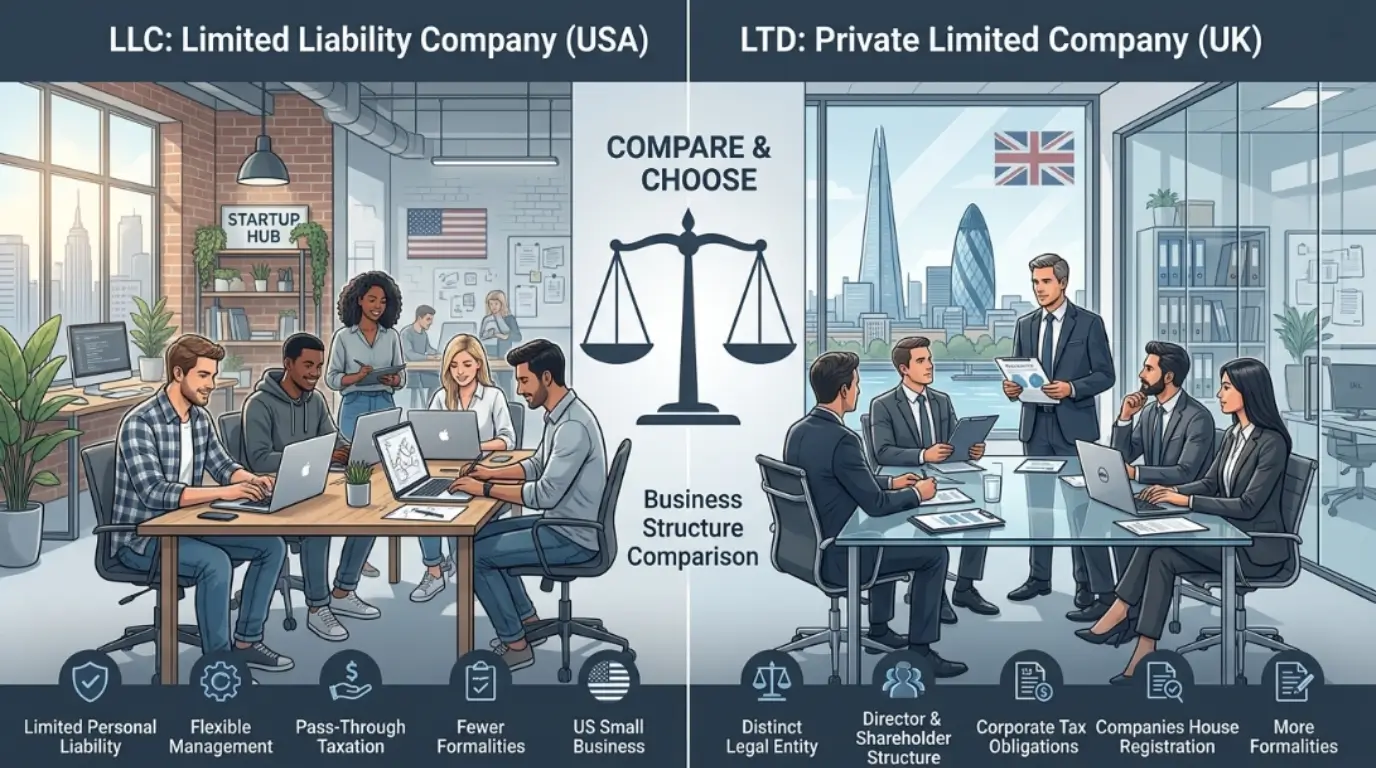
Imagine two friends starting businesses in different countries. One opens a café in the United States, choosing an LLC (Limited Liability Company) to protect personal assets.
The other launches a tech startup in the United Kingdom, registering it as an LTD (Limited Company) to gain credibility and legal structure.
Both are running successful businesses, but their legal setups are different. This is where the difference between LLC and LTD becomes important to understand.
The difference between LLC and LTD affects taxes, ownership, and legal responsibilities. Many beginners confuse the difference between LLC and LTD, thinking they are the same thing with different names. However, the difference between LLC and LTD plays a major role in how businesses operate globally.
Key Difference Between LLC and LTD
The main difference lies in geography, taxation, and structure. An LLC is commonly used in the USA, while an LTD is widely used in the UK and other Commonwealth countries.
Why It’s Important to Know the Difference
Understanding this difference helps entrepreneurs choose the right structure, avoid legal issues, and manage taxes effectively.
Pronunciation
- LLC: /ˌel.elˈsiː/ (US & UK same)
- LTD: /ˌel.tiːˈdiː/ (US & UK same)
Now let’s connect this to a deeper breakdown of how both actually differ in real business practice.
Difference Between LLC and LTD
Here are 10 clear differences with simple explanations and examples:
1. Country of Use
- LLC: Mostly used in the USA
Example: A small bakery in Texas registers as an LLC.
Example: A freelance designer in California forms an LLC. - LTD: Common in the UK and Commonwealth countries
Example: A London-based marketing agency becomes an LTD.
Example: A Manchester retail shop is registered as LTD.
2. Ownership Structure
- LLC: Flexible ownership, can have one or multiple owners
Example: A solo consultant forms a single-member LLC.
Example: Three partners open a consulting LLC. - LTD: Owned by shareholders
Example: A UK tech startup has 5 shareholders.
Example: A retail chain issues shares to investors.
3. Tax System
- LLC: Pass-through taxation (income goes to owners)
Example: Owner pays personal tax on profits.
Example: No separate company tax in some cases. - LTD: Corporate tax applies
Example: The company pays tax before distributing profits.
Example: Shareholders pay tax on dividends.
4. Legal Identity
- LLC: Separate legal entity but flexible
Example: Company can sue or be sued independently.
Example: Business owns its own assets. - LTD: Fully separate legal entity
Example: LTD owns property and contracts.
Example: Directors are not personally liable.
5. Liability Protection
- LLC: Limited liability for owners
Example: Personal car is safe from business debt.
Example: Home is protected from lawsuits. - LTD: Limited liability for shareholders
Example: Shareholder loses only investment.
Example: Personal savings remain safe.
6. Management Style
- LLC: Managed by owners or managers
Example: Owner runs daily operations.
Example: Managers handle business tasks. - LTD: Managed by directors
Example: Board of directors makes decisions.
Example: CEO runs company operations.
7. Formation Process
- LLC: Easier and faster to form
Example: Register online in a few steps.
Example: Lower documentation required. - LTD: More formal process
Example: Requires registration with Companies House.
Example: Needs legal documents and filings.
8. Profit Distribution
- LLC: Flexible profit sharing
Example: One owner can take 70% profit.
Example: Profits shared based on agreement. - LTD: Based on shares
Example: 60% shareholder gets more profit.
Example: Dividends distributed per share.
9. Compliance Rules
- LLC: Fewer reporting requirements
Example: Minimal annual reporting.
Example: Simple tax filing. - LTD: Strict compliance rules
Example: Annual financial reports required.
Example: Must follow corporate regulations.
10. Global Recognition
- LLC: Mainly recognized in the USA
Example: May face confusion in Europe.
Example: Needs explanation in international trade. - LTD: Widely recognized globally
Example: Easier for international investors.
Example: Accepted in many countries.
Nature and Behaviour of LLC and LTD
An LLC is flexible, informal in structure, and designed for small to medium businesses that want simplicity. It behaves like a partnership with legal protection, making it popular among startups and freelancers.
An LTD, on the other hand, is more formal and structured. It behaves like a corporate entity with strict rules, making it suitable for larger businesses and companies aiming for global expansion.
Why People Get Confused
People often confuse LLC and LTD because both provide limited liability protection. However, the confusion arises because different countries use different terms for similar concepts. Additionally, online business content often mixes them without explaining legal differences clearly.
Table: Difference Between LLC and LTD
| Feature | LLC | LTD |
| Country | USA | UK & Commonwealth |
| Tax | Pass-through | Corporate tax |
| Ownership | Members | Shareholders |
| Structure | Flexible | Formal |
| Management | Owners/Managers | Directors |
| Compliance | Simple | Strict |
Which Is Better and When?
Choosing between LLC and LTD depends on your location and business goals. If you want flexibility, fewer rules, and are operating in the US, an LLC is better. It is ideal for freelancers, startups, and small businesses.
If you want credibility, structured growth, and international recognition, an LTD is better. It is suitable for companies planning expansion, attracting investors, or operating in the UK or global markets.
Connotative Meaning of LLC and LTD
- LLC: Positive connotation (flexibility, protection, independence)
- LTD: Positive connotation (trust, structure, professionalism)
Both are neutral legally but carry positive business perception in different regions.
Idioms / Metaphorical Use
- “LLC mindset” → used for flexible, startup-style thinking
Example: “His LLC mindset helped him adapt quickly.” - “LTD structure” → used for formal, corporate systems
Example: “The company runs with an LTD structure approach.”
LLC and LTD in Literature (Examples)
- LLC: Not commonly used in literature but appears in modern business writing (Business Law texts, USA, 2000s)
- LTD: Mentioned in UK corporate law books (e.g., Company Law by Paul Davies, 2010 edition)
Movies Related to Business Concepts
- “The Social Network” (2010, USA) – startup structure (LLC-like environment)
- “The Founder” (2016, USA) – corporate expansion (LTD-like structure)
FAQs
1. Is LLC better than LTD?
It depends on your country and business needs.
2. Can LLC operate in the UK?
Not commonly; UK uses LTD structure instead.
3. Is LTD more expensive to maintain?
Yes, due to stricter compliance requirements.
4. Do both protect personal assets?
Yes, both offer limited liability protection.
5. Which is better for startups?
LLC is often better for startups due to flexibility.
Conclusion
Understanding the difference between LLC and LTD is essential for anyone starting or managing a business.
Both structures offer protection and credibility, but they serve different legal systems and business needs. The difference between LLC and LTD is mainly about geography, taxation, and structure, which directly affects how businesses operate.
Choosing the right one depends on your goals, location, and future expansion plans. By clearly knowing the difference between LLC and LTD, entrepreneurs can make smarter, safer, and more profitable decisions for long-term success.