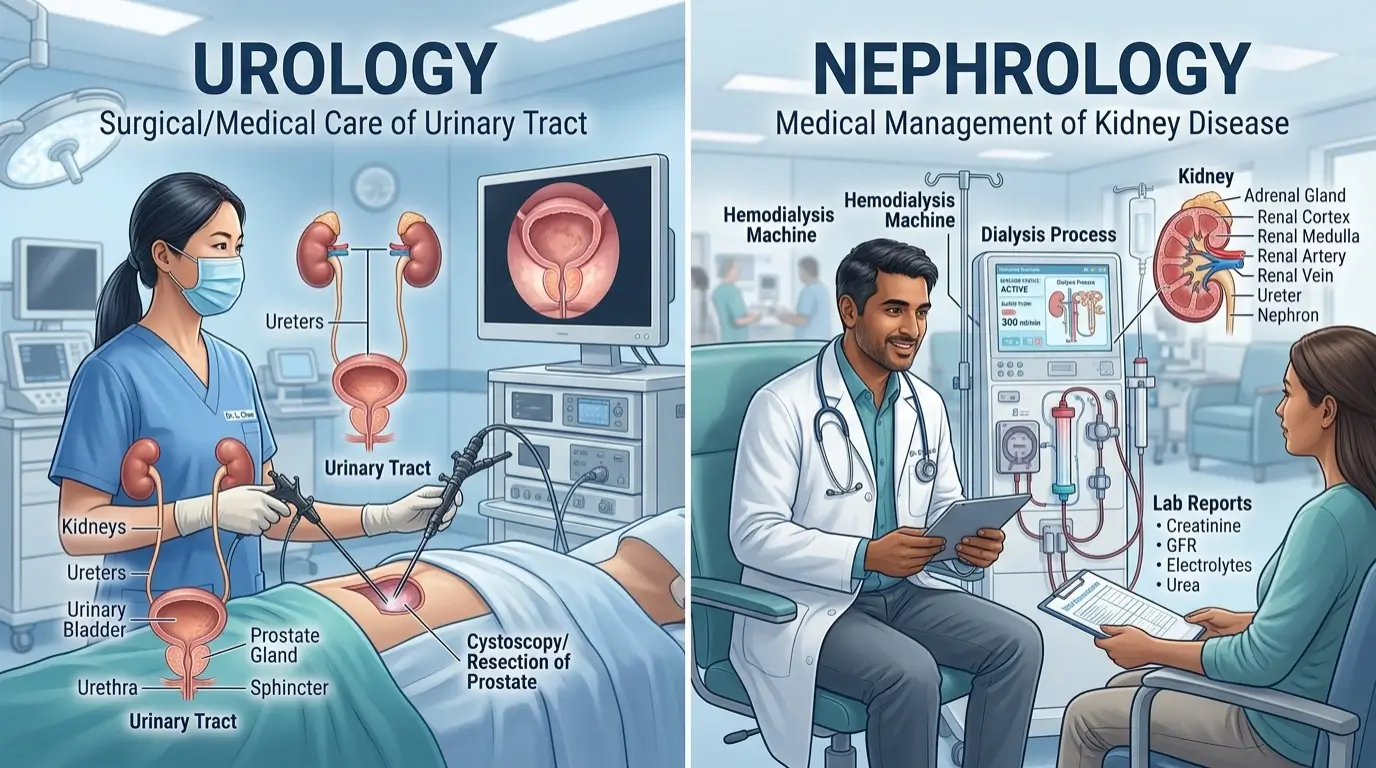
A few days ago, a patient visited a hospital with severe pain during urination. He was confused should he see a urologist or a nephrologist? This is where the difference between urology and nephrology becomes important.
Many people don’t understand the difference between urology and nephrology, even though both deal with the urinary system. The difference between urology and nephrology lies in their focus one handles surgical issues, while the other focuses on medical kidney care.
Knowing the difference between urology and nephrology helps patients choose the right specialist quickly and avoid delays in treatment.
Pronunciation (US & UK)
- Urology:
- US: yoo-ROL-uh-jee
- UK: yoo-ROL-uh-jee
- Nephrology:
- US: neh-FROL-uh-jee
- UK: neh-FROL-uh-jee
Understanding this difference leads us to explore how these two fields work in real life.
Key Difference Between Urology and Nephrology
- Urology focuses on surgical and structural problems of the urinary tract.
- Nephrology focuses on medical (non-surgical) kidney diseases.
Why Their Difference Is Important in Society
Knowing the difference between urology and nephrology helps patients get the right care at the right time. It reduces misdiagnosis and saves time. For learners and experts, it builds clarity in medical studies. In society, this knowledge improves healthcare awareness and leads to better treatment outcomes.
Difference Between Urology and Nephrology (10 Key Points)
1. Field Focus
- Urology: Urinary tract + male reproductive system
- Example 1: Kidney stones
- Example 2: Prostate issues
- Nephrology: Kidney function and diseases
- Example 1: Kidney failure
- Example 2: Glomerulonephritis
2. Treatment Type
- Urology: Surgical treatments
- Example 1: Stone removal surgery
- Example 2: Tumor removal
- Nephrology: Medical treatments
- Example 1: Dialysis
- Example 2: Blood pressure control
3. Organs Covered
- Urology: Kidney, bladder, ureters, urethra
- Example 1: Bladder infection
- Example 2: Urinary blockage
- Nephrology: Only kidneys
- Example 1: Chronic kidney disease
- Example 2: Kidney inflammation
4. Specialist Role
- Urologist: Surgeon
- Example 1: Performs operations
- Example 2: Uses surgical tools
- Nephrologist: Physician
- Example 1: Prescribes medicines
- Example 2: Manages long-term care
5. Common Conditions
- Urology: Stones, cancers
- Example 1: Kidney stones
- Example 2: Bladder cancer
- Nephrology: Kidney disorders
- Example 1: Kidney failure
- Example 2: Electrolyte imbalance
6. Procedures
- Urology: Surgical procedures
- Example 1: Cystoscopy
- Example 2: Lithotripsy
- Nephrology: Non-surgical
- Example 1: Dialysis
- Example 2: Lab tests
7. Training Focus
- Urology: Surgery training
- Example 1: Surgical techniques
- Example 2: Operation management
- Nephrology: Internal medicine
- Example 1: Disease diagnosis
- Example 2: Drug therapy
8. Patient Cases
- Urology: Structural problems
- Example 1: Blocked urine flow
- Example 2: Enlarged prostate
- Nephrology: Functional problems
- Example 1: Poor filtration
- Example 2: Toxin buildup
9. Use of Technology
- Urology: Surgical tools
- Example 1: Laser surgery
- Example 2: Endoscopy
- Nephrology: Monitoring tools
- Example 1: Blood tests
- Example 2: Dialysis machines
10. Emergency Role
- Urology: Immediate surgical care
- Example 1: Stone blockage
- Example 2: Trauma
- Nephrology: Chronic care
- Example 1: Long-term kidney disease
- Example 2: Dialysis management
Nature and Behaviour of Both Fields
Urology is practical and procedure-based. It focuses on fixing physical problems.
Nephrology is analytical and long-term. It focuses on managing internal conditions.
Why People Are Confused
Both deal with kidneys and urine. The overlap in organs creates confusion. But their approach—surgical vs medical—is different.
Table: Difference and Similarity
| Aspect | Urology | Nephrology | Similarity |
| Focus | Urinary system | Kidneys | Both treat kidney-related issues |
| Treatment | Surgical | Medical | Both improve patient health |
| Specialist | Surgeon | Physician | Both are doctors |
| Conditions | Stones, tumors | Kidney disease | Work on urinary health |
Which Is Better in What Situation?
If you have a structural issue like a kidney stone or blockage, urology is better. It provides fast surgical solutions. If you have kidney failure or long-term disease, nephrology is better. It offers medical management and long-term care. Both are important depending on the condition.
Metaphors and Similes
- Urology is like a mechanic fixing pipes.
- Nephrology is like a scientist monitoring water quality.
Connotative Meaning
- Urology: Neutral (linked with surgery)
- Example: “He visited urology for treatment.”
- Nephrology: Neutral to positive (linked with care)
- Example: “Nephrology saved his kidney function.”
Idioms or Proverbs
(No direct idioms exist, but usage examples:)
- “Fix the flow” (related to urology problems)
- “Protect the filter” (related to nephrology care)
Works in Literature
- The Citadel – A.J. Cronin (Medical fiction, 1937)
- Complications – Atul Gawande (Medical essays, 2002)
Movies Related to Medical Fields
- The Doctor (1991, USA)
- Patch Adams (1998, USA)
FAQs
1. What is the main difference?
Urology is surgical, nephrology is medical.
2. Who treats kidney stones?
A urologist.
3. Who manages kidney failure?
A nephrologist.
4. Can both work together?
Yes, in complex cases.
5. Why is it important?
It helps choose the right doctor quickly.
How Both Are Useful for Surroundings
Both fields improve public health. Urology solves urgent problems. Nephrology manages long-term diseases. Together, they ensure complete care of the urinary system.
Final Words
The difference between urology and nephrology is simple but important. Urology deals with surgical and structural issues, while nephrology focuses on kidney function and medical care. Understanding this difference helps patients get the right treatment without confusion.
Both fields are essential in healthcare and work together to improve lives. By knowing where to go, people can save time, reduce stress, and get better results. In the end, both specialties play a vital role in keeping our bodies healthy and balanced.