The terms Python and Boa often appear together because both are large snakes that belong to the same reptile group. Imagine a wildlife enthusiast visiting a tropical forest and spotting a huge snake hanging from a tree.
At first glance, it may be difficult to determine whether it is a python or a boa. This confusion is common because these snakes share many physical features and hunting behaviors.
Understanding the difference between python and boa is important for students, wildlife lovers, researchers, and pet owners.
The difference between python and boa helps identify species correctly and understand their habitats and behaviors.
Learning the difference between python and boa also improves knowledge of animal classification and conservation.
This guide explains the difference between python and boa in a simple and easy-to-understand way.
Key Difference Between Python and Boa
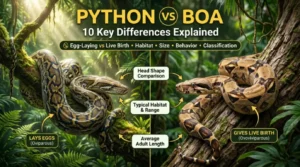
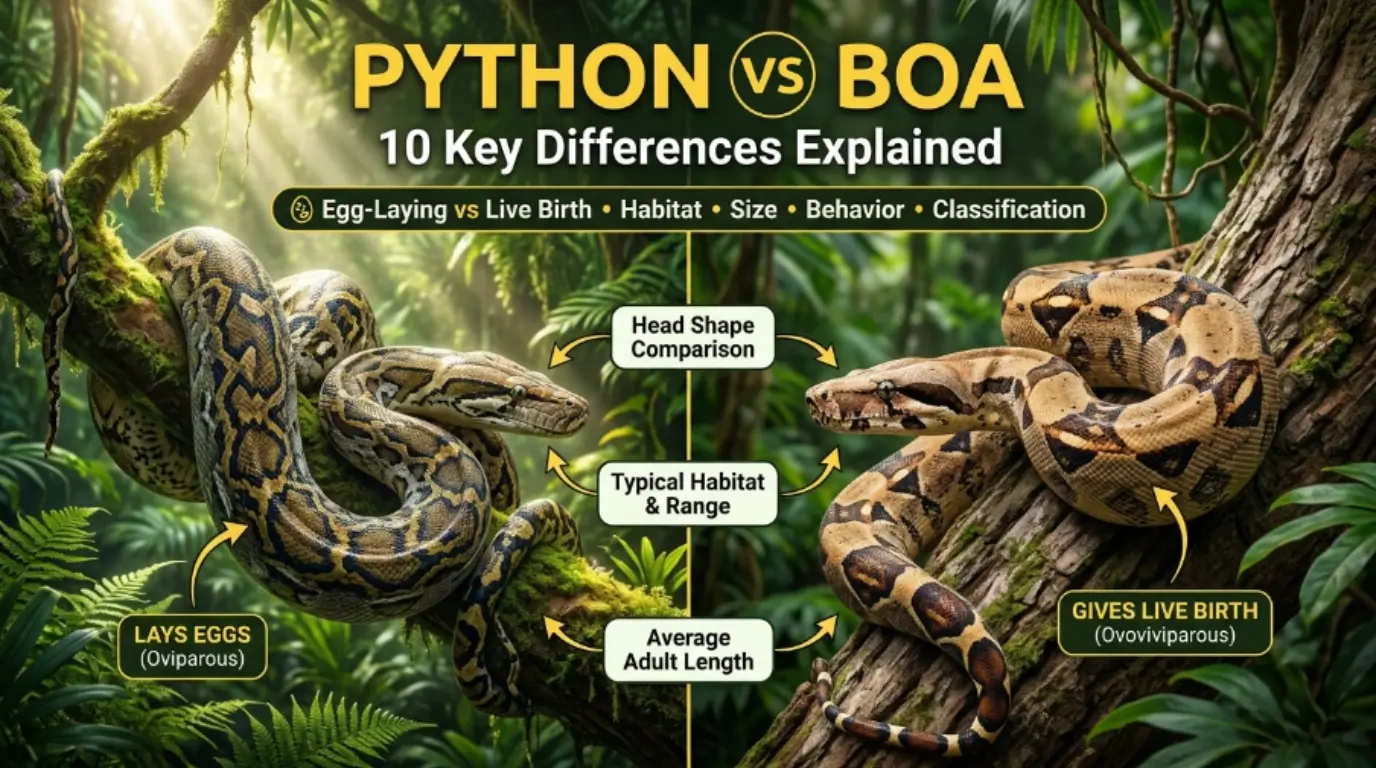
The primary difference is that pythons lay eggs, while boas give birth to live young. This reproductive distinction is one of the easiest ways scientists classify these snake families.
Why Is Their Difference Necessary to Know for Learners and Experts?
Knowing the difference helps wildlife researchers classify species accurately. It also helps pet owners provide suitable care and understand the natural behavior of these snakes.
For students and experts, learning these differences improves understanding of biodiversity, animal evolution, and ecosystem balance. Accurate identification is also important in wildlife conservation programs.
Pronunciation
Python
- US: PIE-thahn
- UK: PIE-thun
Boa
- US: BOH-uh
- UK: BOH-uh
Although they sound different, many people confuse them because they share similar appearances. Let’s explore their differences in detail.
Difference Between Python and Boa
1. Reproduction
Python
- Lays eggs.
- Female often coils around eggs for protection.
Examples:
- Burmese Python lays eggs.
- Reticulated Python lays eggs.
Boa
- Gives birth to live young.
- Babies develop inside the mother’s body.
Examples:
- Boa Constrictor gives live birth.
- Rainbow Boa gives live birth.
2. Geographic Distribution
Python
- Found in Africa, Asia, and Australia.
Examples:
- Indian Python in South Asia.
- Carpet Python in Australia.
Boa
- Mostly found in North, Central, and South America.
Examples:
- Boa Constrictor in South America.
- Cuban Boa in the Caribbean.
3. Family Classification
Python
- Belongs to Pythonidae family.
Examples:
- Ball Python.
- African Rock Python.
Boa
- Belongs to Boidae family.
Examples:
- Emerald Tree Boa.
- Dumeril’s Boa.
4. Egg Tooth
Python
- Hatchlings possess an egg tooth.
Examples:
- Burmese Python hatchlings.
- Ball Python hatchlings.
Boa
- No egg tooth needed.
Examples:
- Boa Constrictor newborn.
- Rainbow Boa newborn.
5. Maternal Care
Python
- Females often guard eggs.
Examples:
- African Rock Python protects nests.
- Burmese Python incubates eggs.
Boa
- Usually little parental care after birth.
Examples:
- Boa Constrictor.
- Sand Boa.
6. Habitat Preference
Python
- Common in forests, grasslands, and wetlands.
Examples:
- Reticulated Python in rainforests.
- Water Python near wetlands.
Boa
- Found in forests, deserts, and trees.
Examples:
- Emerald Tree Boa.
- Rosy Boa.
7. Body Structure
Python
- Generally more muscular and longer.
Examples:
- Reticulated Python.
- Burmese Python.
Boa
- Often slightly heavier-bodied.
Examples:
- Boa Constrictor.
- Red-tailed Boa.
8. Heat-Sensing Pits
Python
- Usually has well-developed heat pits.
Examples:
- Ball Python.
- Carpet Python.
Boa
- Heat pits may be fewer or less developed.
Examples:
- Emerald Tree Boa.
- Boa Constrictor.
9. Maximum Size
Python
- Includes some of the world’s longest snakes.
Examples:
- Reticulated Python.
- Burmese Python.
Boa
- Usually shorter but still large.
Examples:
- Boa Constrictor.
- Cuban Boa.
10. Distribution Diversity
Python
- Greater species diversity in Asia and Australia.
Examples:
- Children’s Python.
- Green Tree Python.
Boa
- Greater diversity in the Americas.
Examples:
- Rainbow Boa.
- Tree Boa.
Nature and Behavior
Python
Pythons are generally ambush predators. They remain hidden and strike quickly when prey comes close. Most species are non-venomous and use constriction to kill prey.
Boa
Boas are also constrictors and usually display calm behavior. Many species adapt well to captivity, making them popular among reptile enthusiasts.
Why Are People Confused About Their Use?
People often confuse pythons and boas because both are large, non-venomous constrictor snakes. Their body shape, hunting style, and appearance look similar. Movies, books, and media often use the names interchangeably, adding to the confusion.
Difference and Similarity Table
| Feature | Python | Boa |
| Reproduction | Lays eggs | Gives live birth |
| Family | Pythonidae | Boidae |
| Main Regions | Africa, Asia, Australia | Americas |
| Egg Tooth | Present | Absent |
| Maternal Care | Common | Limited |
| Venom | Non-venomous | Non-venomous |
| Hunting Style | Constriction | Constriction |
| Size | Often longer | Often heavier |
| Habitat | Forests, wetlands | Forests, deserts |
| Similarity | Large constrictor snake | Large constrictor snake |
Which Is Better in What Situation?
For scientific study of egg-laying snakes, pythons provide valuable examples of reptile incubation behavior. Their large size and diverse habitats make them important subjects for ecological research.
For beginner reptile keepers, some boa species are often considered easier to manage because of their calm temperament and live-bearing reproduction. However, the best choice depends on experience, available space, and local regulations.
How the Words Are Used in Metaphors and Similes
Python
Metaphors:
- He was a python in negotiations, slowly squeezing every advantage.
Similes:
- She wrapped around the problem like a python around its prey.
Boa
Metaphors:
- The traffic jam was a boa constrictor around the city.
Similes:
- The scarf hung like a boa around her shoulders.
Connotative Meaning
Python
Positive:
- Strength
- Intelligence
- Patience
Negative:
- Danger
- Fear
Neutral:
- Large snake species
Examples:
- His patience was like a python waiting for the right moment.
- The rumor spread fear like a giant python.
Boa
Positive:
- Grace
- Adaptability
Negative:
- Restriction
- Pressure
Neutral:
- Constrictor snake
Examples:
- The team held the lead like a boa holding prey.
- The schedule felt like a boa tightening around his day.
Idioms or Proverbs Related to the Words
There are no widely recognized English idioms specifically using python or boa. However, related snake expressions include:
- Snake in the grass
- Raise a snake in one’s bosom
- A snake sheds its skin but not its nature
Examples:
- He seemed friendly but turned out to be a snake in the grass.
- Trusting him again is like raising a snake in your bosom.
Works in Literature
Python
- Python – Poetry, Christopher Smart, 1752
- References in Greek mythology involving the Python serpent
Boa
- The Little Prince – Children’s Literature, Antoine de Saint-Exupéry, 1943
- Features the famous boa constrictor illustration
Movies Featuring Python or Boa
Python
- Python (2000) – United States
- Python II (2002) – United States
Boa
- Boa (2001) – United States
- Boa vs. Python (2004) – United States
Frequently Asked Questions
What is the biggest difference between python and boa?
Pythons lay eggs, while boas give birth to live young.
Are both snakes venomous?
No. Both are non-venomous constrictors.
Which snake grows larger?
Many python species grow longer than most boas.
Can pythons and boas be kept as pets?
Yes, some species are popular pets when cared for properly.
Why do people confuse pythons and boas?
They have similar appearances, behaviors, and hunting methods.
How Both Are Useful for Surroundings
Pythons and boas help control populations of rodents and other small animals. This natural pest control helps maintain ecological balance in forests, grasslands, and agricultural areas.
These snakes also play an important role in food chains. By regulating prey populations, they contribute to healthy ecosystems and biodiversity.
Final Words
Understanding the difference between python and boa helps us appreciate the diversity of the natural world.
While both snakes are powerful constrictors with similar appearances, important distinctions exist in reproduction, classification, habitat, and behavior.
These differences allow scientists and wildlife enthusiasts to identify and study them accurately.
Whether you are a student, researcher, pet owner, or simply curious about reptiles, learning about pythons and boas provides valuable insight into animal evolution and ecological balance.
Both snakes play important roles in nature, helping maintain healthy ecosystems and demonstrating the remarkable variety found within the reptile world.