Imagine hearing a news report that someone has been charged with a crime. A few months later, the same person is reported as being convicted.
Many people assume these two terms mean the same thing, but they represent very different stages of the legal process.
Understanding the difference between charged and convicted is important for students, legal professionals, journalists, and ordinary citizens.
Being charged does not automatically mean a person is guilty. A conviction comes only after a court determines guilt through a legal process. This distinction protects fairness and justice in society.
The difference between charged and convicted affects how people are viewed by the public, how legal rights are applied, and how criminal records are maintained.
In this article, we will explore the difference between charged and convicted, their meanings, pronunciations, uses, examples, and why understanding the distinction matters.
Key Difference Between Charged and Convicted
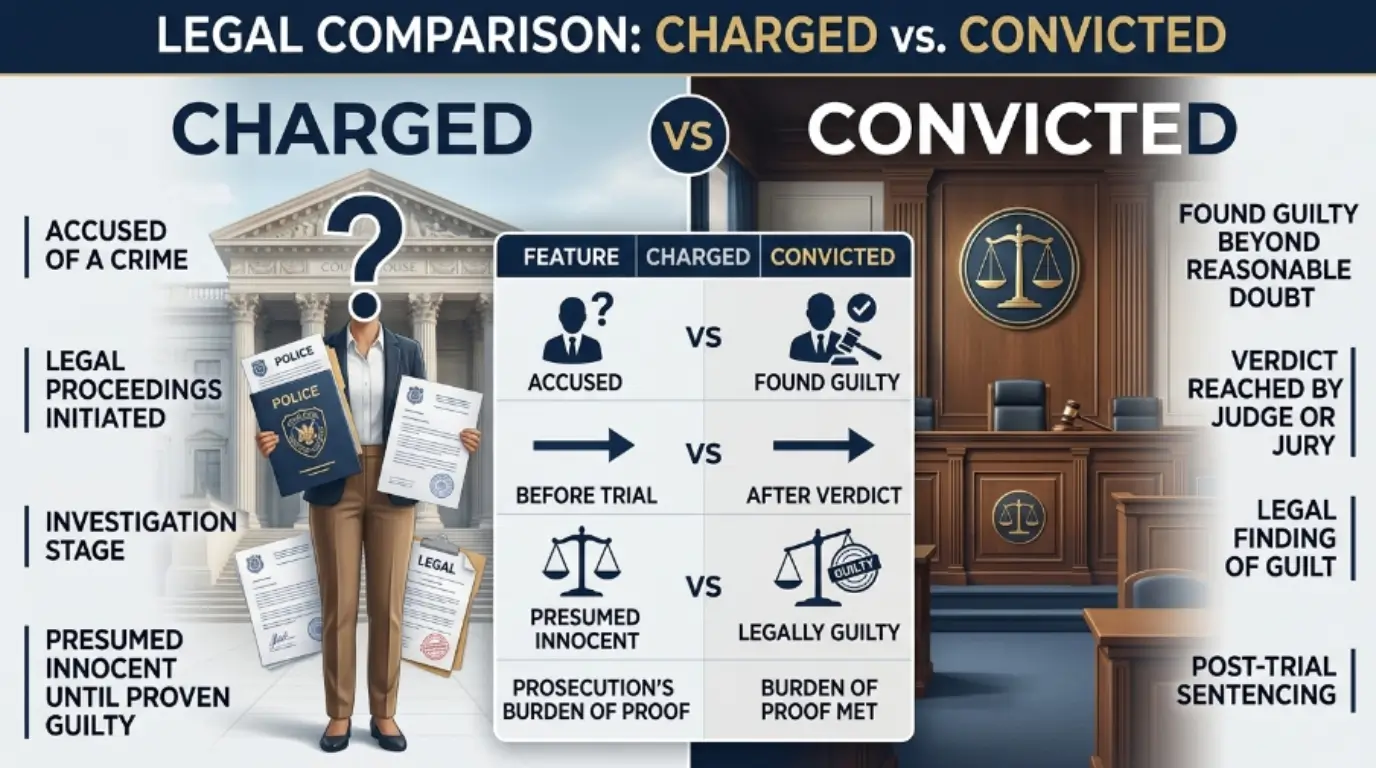
A person is charged when authorities formally accuse them of committing a crime.
A person is convicted when a court finds them guilty of that crime after legal proceedings.
In simple words:
- Charged = Accused
- Convicted = Found Guilty
Why Is Their Difference Necessary to Know?
Understanding this distinction is important because it helps people avoid unfair judgments.
- It protects the principle of innocent until proven guilty.
- It improves legal literacy among citizens.
- It helps journalists report accurately.
- It prevents misinformation in public discussions.
- It supports fair treatment in workplaces and communities.
- It assists legal experts and students in understanding criminal procedures.
Pronunciation
Charged
US: /tʃɑrdʒd/
UK: /tʃɑːdʒd/
Convicted
US: /kənˈvɪk.tɪd/
UK: /kənˈvɪk.tɪd/
Now that we understand their meanings and pronunciations, let’s examine the detailed differences between them.
Difference Between Charged and Convicted
1. Legal Status
Charged: A formal accusation is made.
Convicted: Guilt has been legally established.
Examples of Charged:
- Sarah was charged with theft.
- Police charged him with assault.
Examples of Convicted:
- Sarah was convicted after trial.
- He was convicted of assault.
2. Stage in Legal Process
Charged: Occurs at the beginning of a criminal case.
Convicted: Occurs near the end of the case.
Examples of Charged:
- Charges were filed yesterday.
- The suspect was charged immediately.
Examples of Convicted:
- The defendant was convicted after six months.
- The jury convicted him.
3. Presumption of Innocence
Charged: Person remains legally innocent.
Convicted: Person is legally guilty.
Examples of Charged:
- She was charged but denied wrongdoing.
- Being charged does not prove guilt.
Examples of Convicted:
- The conviction confirmed guilt.
- A convicted person has lost the presumption of innocence.
4. Evidence Requirement
Charged: Requires probable cause or reasonable suspicion.
Convicted: Requires proof beyond a reasonable doubt in most criminal cases.
Examples of Charged:
- Police had enough evidence to charge him.
- Investigators filed charges.
Examples of Convicted:
- Strong evidence led to conviction.
- Witness testimony supported conviction.
5. Court Decision
Charged: No court ruling yet.
Convicted: Court has issued a finding of guilt.
Examples of Charged:
- Charges were announced before trial.
- The accused awaited court proceedings.
Examples of Convicted:
- The judge entered a conviction.
- The jury reached a guilty verdict.
6. Criminal Record Impact
Charged: May appear in records but is not proof of guilt.
Convicted: Creates a conviction record.
Examples of Charged:
- Background checks showed pending charges.
- Charges remained unresolved.
Examples of Convicted:
- His conviction appeared on the record.
- Employers noticed the conviction.
7. Public Perception
Charged: Often creates suspicion.
Convicted: Usually confirms wrongdoing in public opinion.
Examples of Charged:
- The public discussed the charges.
- Media covered the accusation.
Examples of Convicted:
- The conviction changed public opinion.
- People accepted the court’s decision.
8. Legal Consequences
Charged: May involve bail and court appearances.
Convicted: May involve penalties and sentencing.
Examples of Charged:
- He posted bail after being charged.
- She attended preliminary hearings.
Examples of Convicted:
- He received a prison sentence.
- She paid a court-ordered fine.
9. Outcome Possibility
Charged: Charges may be dismissed.
Convicted: Conviction remains unless overturned.
Examples of Charged:
- Charges were dropped.
- Prosecutors dismissed the case.
Examples of Convicted:
- The conviction was appealed.
- The conviction remained valid.
10. Rights and Restrictions
Charged: Most legal rights remain intact.
Convicted: Certain rights may be limited depending on laws.
Examples of Charged:
- He could continue working.
- She maintained her legal status.
Examples of Convicted:
- Convicted offenders may face restrictions.
- Certain licenses may be affected.
Nature and Behaviour of Both Terms
Charged
The term is procedural and accusatory. It indicates that legal authorities believe there is enough evidence to begin a criminal case.
Convicted
The term is judicial and conclusive. It reflects a court’s decision that a person committed the offense.
Why Are People Confused About Their Use?
People often confuse these terms because media headlines frequently focus on arrests and charges. Many readers assume that a charge automatically proves guilt. In reality, a charge only starts the legal process, while a conviction completes it with a finding of guilt.
Difference and Similarity Table
| Feature | Charged | Convicted |
| Meaning | Formally accused | Found guilty |
| Legal Status | Presumed innocent | Legally guilty |
| Stage | Beginning of case | End of case |
| Court Decision | Not yet | Yes |
| Punishment | Usually none yet | Possible sentence |
| Criminal Record | Pending matter | Confirmed conviction |
| Evidence Standard | Probable cause | Beyond reasonable doubt |
| Rights | Mostly retained | May be restricted |
| Can Be Reversed | Charges may be dropped | Conviction may be appealed |
| Similarity | Both relate to criminal proceedings | Both relate to criminal proceedings |
Which Is Better in What Situation?
Being charged is generally a less serious legal position because guilt has not been established. The person still has the opportunity to defend themselves and may be cleared of all allegations.
Being convicted is not considered better from a legal perspective because it means the court has found sufficient evidence to determine guilt. However, a conviction provides legal finality and resolution to a case, which may be important for victims and society.
How Are They Used in Metaphors and Similes?
Charged
Metaphorical Meaning: Full of energy, tension, or emotion.
Examples:
- The room was charged with excitement.
- The atmosphere felt charged before the announcement.
Convicted
Metaphorical Meaning: Strongly persuaded or firmly convinced.
Examples:
- She was convicted of her beliefs.
- He spoke like a convicted supporter of the cause.
Connotative Meanings
Charged
Positive:
- Charged with enthusiasm.
- Charged with responsibility.
Negative:
- Charged with fraud.
- Charged with misconduct.
Neutral:
- Charged under the law.
Convicted
Positive:
- Convicted in personal beliefs.
- Convicted advocate for justice.
Negative:
- Convicted criminal.
- Convicted offender.
Neutral:
- Convicted after legal proceedings.
Idioms and Expressions Related to the Words
Charged
- Charged atmosphere
- Fully charged
- Charged with responsibility
Examples:
- The stadium had a charged atmosphere.
- My phone is fully charged.
- She was charged with leading the project.
Convicted
- Convicted by conscience
- Convicted of wrongdoing
Examples:
- He felt convicted by his conscience.
- The court convicted him of fraud.
Literary Works Related to Crime, Charges, and Convictions
- To Kill a Mockingbird – Novel – Harper Lee – 1960
- Crime and Punishment – Psychological Fiction – Fyodor Dostoevsky – 1866
- The Trial – Absurdist Fiction – Franz Kafka – 1925
- A Time to Kill – Legal Thriller – John Grisham – 1989
Movies Related to Charges and Convictions
- The Trial of the Chicago 7 – 2020 – United States
- Just Mercy – 2019 – United States
- The Hurricane – 1999 – United States
- Primal Fear – 1996 – United States
Frequently Asked Questions
Is being charged the same as being convicted?
No. Being charged means being accused, while being convicted means being found guilty.
Can someone be charged and never convicted?
Yes. Charges can be dismissed, withdrawn, or result in acquittal.
Does a charge appear on a background check?
In some jurisdictions, pending charges may appear on certain background checks.
Can a conviction be overturned?
Yes. Appeals or new evidence can sometimes overturn convictions.
Which happens first, charged or convicted?
A person is charged first and may later be convicted after court proceedings.
How Both Are Useful for Society
Both concepts serve important purposes in the justice system. Charges allow authorities to investigate and prosecute suspected crimes, while convictions help enforce accountability when guilt is proven.
Together, they create a structured legal process that balances public safety with individual rights. Without charges, crimes might go unaddressed. Without convictions, courts would be unable to deliver justice after proving guilt.
Conclusion
The difference between charged and convicted is one of the most important distinctions in criminal law.
A charge is simply a formal accusation that begins a legal case, while a conviction is a court’s determination that a person is guilty.
Understanding this difference helps prevent misunderstandings, protects the principle of innocence until proven guilty, and promotes accurate discussions about legal matters.
Whether you are a student, journalist, legal professional, or curious reader, knowing the distinction between being charged and being convicted can improve your understanding of how justice works.
Remember: every convicted person was once charged, but not every charged person becomes convicted.