The difference between veneers and dentures is a topic many people search when looking for ways to improve their smile.
Imagine two friends visiting a dentist. One has healthy teeth but wants a brighter and more attractive smile.
The other has lost several teeth and needs a solution to eat and speak comfortably again.
Although both want better oral health, the dentist recommends veneers for one and dentures for the other. This example shows why understanding the difference between veneers and dentures is important.
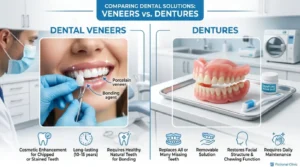
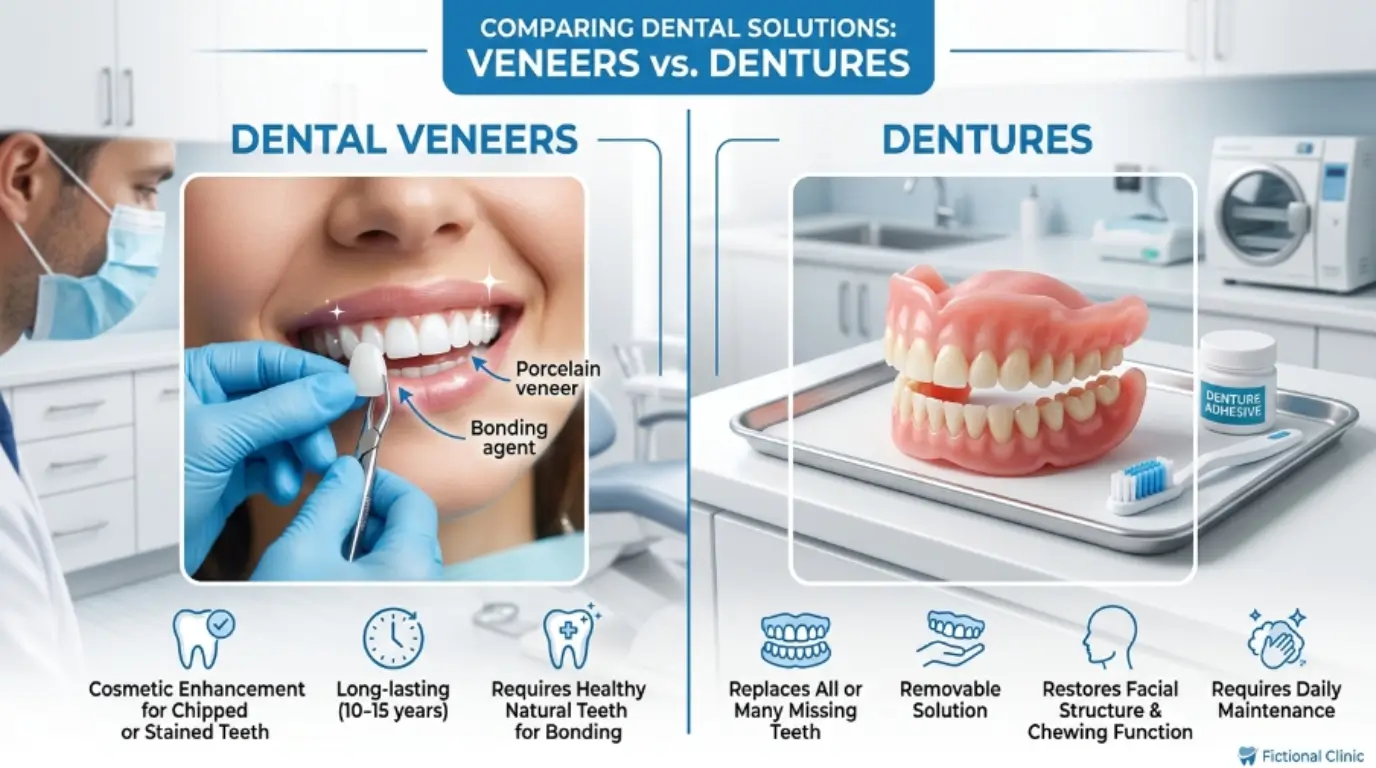
The difference between veneers and dentures lies mainly in their purpose, structure, and use. Veneers are thin coverings placed on existing teeth, while dentures replace missing teeth.
Learning the difference between veneers and dentures helps patients choose the right treatment and understand dental care options more clearly.
Key Difference Between Veneers and Dentures
The main difference is that veneers improve the appearance of natural teeth, whereas dentures replace teeth that are missing.
Why Is Their Difference Important to Know?
Understanding these dental solutions helps patients make informed decisions about oral health. Dentists, students, researchers, and patients benefit from knowing their unique purposes. Proper knowledge prevents confusion, saves money, and ensures the best treatment choice.
Pronunciation
Veneers
- US: /vəˈnɪrz/
- UK: /vəˈnɪəz/
Dentures
- US: /ˈden.tʃərz/
- UK: /ˈden.tʃəz/
Now that we understand the basics, let’s explore the detailed difference between veneers and dentures.
Difference Between Veneers and Dentures
1. Purpose
Veneers
- Improve the appearance of existing teeth.
- Used for cosmetic enhancement.
Examples:
- Covering stained teeth.
- Fixing small gaps.
Dentures
- Replace missing teeth.
- Restore chewing and speaking functions.
Examples:
- Replacing all upper teeth.
- Replacing several missing teeth.
2. Structure
Veneers
- Thin shells made from porcelain or composite material.
- Bonded to tooth surfaces.
Examples:
- Porcelain veneers.
- Composite veneers.
Dentures
- Artificial teeth attached to a removable base.
- Made from acrylic or metal frameworks.
Examples:
- Full dentures.
- Partial dentures.
3. Tooth Requirement
Veneers
- Require healthy natural teeth.
Examples:
- Slightly chipped tooth.
- Discolored tooth.
Dentures
- Used when teeth are missing.
Examples:
- Tooth loss from aging.
- Tooth loss from injury.
4. Permanence
Veneers
- Semi-permanent solution.
- Fixed in place.
Examples:
- Cosmetic smile makeover.
- Long-term aesthetic treatment.
Dentures
- Usually removable.
Examples:
- Removing at night.
- Cleaning after meals.
5. Appearance
Veneers
- Look very similar to natural teeth.
Examples:
- Hollywood smile.
- Uniform tooth color.
Dentures
- Designed to resemble natural teeth but may look less natural.
Examples:
- Traditional dentures.
- Economy dentures.
6. Cost
Veneers
- Generally more expensive per tooth.
Examples:
- Porcelain veneer treatment.
- Cosmetic dental package.
Dentures
- Often less expensive for replacing many teeth.
Examples:
- Complete denture set.
- Partial denture replacement.
7. Maintenance
Veneers
- Brushed like natural teeth.
Examples:
- Daily brushing.
- Regular dental checkups.
Dentures
- Need special cleaning.
Examples:
- Denture cleanser.
- Overnight soaking.
8. Comfort
Veneers
- Feel similar to natural teeth.
Examples:
- Speaking normally.
- Eating comfortably.
Dentures
- May require adjustment periods.
Examples:
- Initial soreness.
- Learning to chew properly.
9. Durability
Veneers
- Can last 10–15 years or more.
Examples:
- Proper oral care.
- Avoiding hard objects.
Dentures
- Typically need replacement after several years.
Examples:
- Worn denture base.
- Changes in jaw shape.
10. Treatment Process
Veneers
- Usually completed in a few visits.
Examples:
- Tooth preparation.
- Final bonding.
Dentures
- Require impressions and fittings.
Examples:
- Initial mold.
- Adjustment appointment.
Nature and Behavior of Both
Veneers
Veneers are cosmetic dental restorations. Their primary behavior is enhancing beauty while preserving natural teeth. They blend naturally with existing teeth and are commonly chosen by people seeking aesthetic improvements.
Dentures
Dentures are restorative dental devices. Their purpose is functional support by replacing missing teeth. They help restore speaking ability, chewing function, and facial appearance.
Why Are People Confused About Their Use?
Many people believe both veneers and dentures serve the same purpose because both improve smiles. However, veneers work with existing teeth, while dentures replace missing teeth. The visual improvement they provide often leads to confusion among patients who are unfamiliar with dental terminology.
Difference and Similarity Table
| Feature | Veneers | Dentures |
| Purpose | Improve appearance | Replace missing teeth |
| Attached To | Natural teeth | Gum-supported base |
| Removable | No | Usually yes |
| Cosmetic Use | High | Moderate |
| Functional Restoration | Limited | High |
| Material | Porcelain/Composite | Acrylic/Metal |
| Lifespan | 10–15+ years | 5–10 years |
| Tooth Requirement | Existing teeth needed | Missing teeth required |
| Comfort | Similar to natural teeth | Adjustment needed |
| Cost | Higher per tooth | Better for multiple replacements |
Similarities
| Similarity |
| Both improve smiles |
| Both require dental care |
| Both enhance confidence |
| Both are custom-made |
| Both involve professional dental treatment |
Which Is Better in What Situation?
Veneers are better for people who already have healthy teeth but want to improve color, shape, size, or alignment. They are ideal for cosmetic enhancement and creating a bright, attractive smile.
Dentures are better for individuals who have lost multiple teeth or all teeth. They restore essential functions such as eating, speaking, and maintaining facial structure. The best option depends on the patient’s oral health condition and treatment goals.
How the Words Are Used in Metaphors and Similes
Veneers
Metaphorical Meaning:
- Something that hides imperfections.
Examples:
- His confidence was a veneer covering his fear.
- The company’s kindness was only a veneer of honesty.
Similes:
- Smooth as a veneer.
- Polished like a veneer.
Dentures
Metaphorical Meaning:
- A replacement or substitute for something lost.
Examples:
- The new policy acted as dentures for a failing system.
- Temporary solutions were dentures for deeper problems.
Similes:
- Reliable like dentures.
- Useful as dentures to a missing smile.
Connotative Meanings
Veneers
Positive
- Beauty
- Elegance
- Confidence
Example:
- Her veneers gave her confidence during presentations.
Negative
- Artificial appearance
- Hidden reality
Example:
- His charm was only a veneer.
Dentures
Positive
- Restoration
- Support
- Functionality
Example:
- Dentures restored his quality of life.
Negative
- Aging association
- Dependence
Example:
- Some people incorrectly associate dentures with weakness.
Idioms or Expressions Related to Teeth
Veneers
- Put on a brave face.
- Smile through it.
Examples:
- She put on a brave face like a veneer over her worries.
- He smiled through it despite challenges.
Dentures
- Long in the tooth.
- Show your teeth.
Examples:
- He may be long in the tooth but remains active.
- The team showed its teeth during competition.
Works in Literature
Veneers
- The Painted Veil – Novel – W. Somerset Maugham – 1925
- The Human Stain – Novel – Philip Roth – 2000
Dentures
- References to dentures appear in modern health memoirs and aging literature.
- Frequently discussed in nonfiction healthcare and dental books.
Movies Related to Dental Themes
Veneers
- Smile – 2022 – USA
- Tooth Fairy – 2010 – USA
Dentures
- The Denture Adventure – Various regional productions
- Novocaine – 2001 – USA
Frequently Asked Questions
Are veneers and dentures the same?
No. Veneers cover existing teeth, while dentures replace missing teeth.
Which lasts longer, veneers or dentures?
Veneers often last longer when properly maintained.
Can dentures look natural?
Yes. Modern dentures can closely resemble natural teeth.
Do veneers replace missing teeth?
No. Veneers require existing teeth and do not replace missing ones.
Which option is more expensive?
Veneers are usually more expensive per tooth, while dentures may be more economical for replacing many teeth.
How Both Are Useful for Surroundings
Veneers and dentures contribute to healthier communities by improving oral health, confidence, communication, and overall well-being.
People with healthy smiles often participate more actively in social and professional environments.These dental solutions also support healthcare systems by addressing cosmetic and restorative needs.
Final Words for Both
Understanding the difference between veneers and dentures is essential for choosing the right dental treatment.
Veneers are excellent for enhancing the appearance of natural teeth, while dentures provide a practical solution for replacing missing teeth. Although both improve smiles and confidence, they serve very different purposes.
Patients should evaluate their oral health needs, budget, and long-term goals before making a decision.
Consulting a dental professional is always the best way to determine whether veneers or dentures are the most suitable option.
By knowing their differences, similarities, and benefits, individuals can make informed choices that lead to healthier smiles and better quality of life.