If you have ever stood in a grocery store looking at small orange citrus fruits, you may have wondered about the difference between mandarin and tangerine.
Many people use these names interchangeably, but they are not exactly the same. Imagine a shopper picking up a sweet, easy-to-peel fruit labeled “mandarin” while another nearby package says “tangerine.”
At first glance, they look almost identical, creating confusion for consumers, students, and even food enthusiasts.
Understanding the difference between mandarin and tangerine helps people make better choices when buying fruit, learning about horticulture, or studying nutrition.
The difference between mandarin and tangerine is mainly related to classification, appearance, taste, and cultivation.
In this guide, we will explore the difference between mandarin and tangerine in simple language, helping learners and experts understand these popular citrus fruits more clearly.
Key Difference Between Mandarin and Tangerine
A mandarin is a broad category of citrus fruit belonging to the mandarin orange family. A tangerine is a specific type of mandarin orange known for its deep orange-red color and slightly stronger flavor.
In simple words:
- All tangerines are mandarins.
- Not all mandarins are tangerines.
Why Is Their Difference Important to Know?
Understanding the difference is valuable because:
- It helps consumers choose fruits based on taste preferences.
- Farmers use accurate classifications for cultivation and marketing.
- Nutritionists recommend specific citrus varieties for diets.
- Students studying botany learn proper plant classifications.
- Food industries label products correctly.
Knowing the distinction improves communication in agriculture, education, and commerce.
Pronunciation
Mandarin
US: /ˈmæn.də.rɪn/
UK: /ˈmæn.dər.ɪn/
Tangerine
US: /ˌtæn.dʒəˈriːn/
UK: /ˌtæn.dʒəˈriːn/
Now that we know how these words are pronounced, let’s explore their differences in greater detail.
Difference Between Mandarin and Tangerine
1. Classification
Mandarin:
Mandarin refers to an entire group of citrus fruits.
Examples:
- Clementine is a mandarin.
- Satsuma is a mandarin.
Tangerine:
Tangerine is one specific variety within the mandarin family.
Examples:
- Dancy Tangerine.
- Honey Tangerine.
2. Color
Mandarin:
Usually light orange.
Examples:
- Satsuma has pale orange skin.
- Clementine has bright orange skin.
Tangerine:
Usually darker orange with reddish tones.
Examples:
- Deep orange tangerines.
- Red-orange Dancy tangerines.
3. Taste
Mandarin:
Generally sweeter and milder.
Examples:
- Clementines are very sweet.
- Satsumas have a gentle flavor.
Tangerine:
Slightly tangier and stronger.
Examples:
- Honey Tangerines have rich flavor.
- Dancy Tangerines have noticeable tartness.
4. Skin Texture
Mandarin:
Thin and smooth skin.
Examples:
- Clementines peel easily.
- Satsumas have loose skin.
Tangerine:
Slightly thicker and rougher skin.
Examples:
- Dancy skin feels textured.
- Some tangerines have firmer peels.
5. Shape
Mandarin:
Often flatter at the top and bottom.
Examples:
- Satsumas appear flattened.
- Many mandarins look slightly squashed.
Tangerine:
More rounded in appearance.
Examples:
- Honey Tangerines are round.
- Dancy Tangerines are nearly spherical.
6. Seed Content
Mandarin:
Many varieties are seedless.
Examples:
- Clementines often have no seeds.
- Seedless Satsumas are common.
Tangerine:
May contain more seeds.
Examples:
- Traditional tangerines contain seeds.
- Older varieties are often seeded.
7. Availability
Mandarin:
Widely available globally.
Examples:
- Sold in supermarkets worldwide.
- Popular in Asia and Europe.
Tangerine:
Less common than mandarins.
Examples:
- Seasonal availability.
- Found mainly in specific markets.
8. Commercial Use
Mandarin:
Used broadly in fresh fruit markets.
Examples:
- Snack packs.
- School lunches.
Tangerine:
Frequently used in specialty products.
Examples:
- Tangerine-flavored beverages.
- Gourmet desserts.
9. Origin of Name
Mandarin:
Named after officials in ancient China.
Examples:
- Chinese cultural association.
- Historical citrus classification.
Tangerine:
Named after Tangier in Morocco.
Examples:
- Fruit exports through Tangier.
- Historical trade routes.
10. Nutritional Focus
Mandarin:
Known for sweetness and vitamin C.
Examples:
- Healthy snacks.
- Children’s diets.
Tangerine:
Known for stronger citrus flavor.
Examples:
- Juices.
- Flavoring ingredients.
Nature and Behaviour
Mandarin
Mandarins are generally sweet, easy to peel, and highly adaptable to different climates. They are popular as snack fruits because of their convenience and pleasant taste.
Tangerine
Tangerines are known for their richer color and slightly sharper flavor. They are often chosen by people who enjoy a stronger citrus taste.
Why Are People Confused About Their Use?
People become confused because:
- Both fruits belong to the same citrus family.
- They have similar sizes and shapes.
- Stores often use the names interchangeably.
- Many consumers are unaware of citrus classifications.
- Some tangerines are marketed simply as mandarins.
Mandarin vs Tangerine: Differences and Similarities
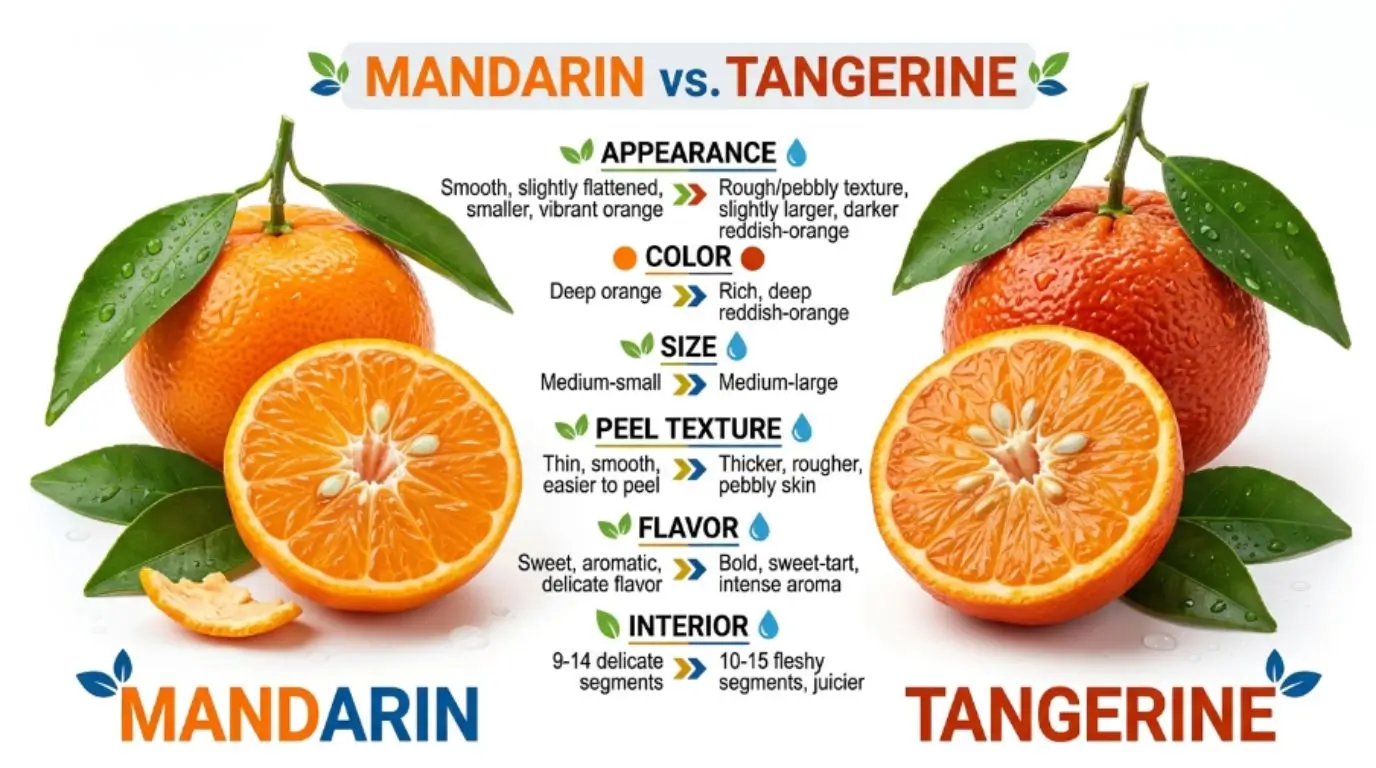
| Feature | Mandarin | Tangerine |
| Category | Citrus group | Type of mandarin |
| Color | Light orange | Deep orange-red |
| Taste | Sweeter | Tangier |
| Shape | Slightly flattened | More rounded |
| Skin | Smooth and thin | Slightly rougher |
| Seeds | Often seedless | May contain seeds |
| Availability | More common | Less common |
| Family | Mandarin family | Mandarin family |
| Vitamin C | High | High |
| Easy to Peel | Yes | Yes |
Which Is Better in Different Situations?
Mandarin
Mandarins are better for everyday snacking because they are usually sweeter, seedless, and easy to peel. They are excellent choices for children, lunchboxes, and quick healthy snacks.
Tangerine
Tangerines are better when a stronger citrus flavor is desired. They work well in juices, fruit salads, desserts, and recipes where a more pronounced taste adds character.
Mandarin and Tangerine in Metaphors and Similes
Mandarin
Metaphor:
- She was the mandarin of the group, bringing sweetness wherever she went.
Simile:
- As sweet as a mandarin on a summer afternoon.
Tangerine
Metaphor:
- His ideas were tangerines among oranges, standing out vividly.
Simile:
- Bright as a tangerine at sunrise.
Connotative Meanings
Mandarin
Positive:
- Sweetness
- Simplicity
- Freshness
Negative:
- Rarely negative
Neutral:
- Citrus fruit classification
Example:
- Her personality was as sweet as a mandarin.
Tangerine
Positive:
- Energy
- Brightness
- Uniqueness
Negative:
- Can imply sharpness or intensity
Neutral:
- Citrus variety
Example:
- His colorful jacket was a tangerine in a sea of gray.
Idioms or Proverbs Related to the Words
There are no widely recognized English idioms specifically using “mandarin” or “tangerine.” However, they can appear in creative expressions.
Examples:
- Sweet as a mandarin.
- Bright as a tangerine.
- A tangerine among oranges.
- Fresh as a mandarin harvest.
Works in Literature
Mandarin
- The Last Mandarin — Historical Fiction, Bruce Chatwin, 1987
- Mandarin — Poetry Collection, various editions
Tangerine
- Tangerine — Young Adult Fiction, Edward Bloor, 1997
- Tangerine — Contemporary Fiction references in modern literature
Movies Related to the Keywords
Mandarin
- The Mandarin (1995, Hungary)
Tangerine
- Tangerine (2015, United States)
Frequently Asked Questions
1. Is a tangerine the same as a mandarin?
No. A tangerine is a type of mandarin orange.
2. Which is sweeter, mandarin or tangerine?
Mandarins are usually sweeter than tangerines.
3. Are both fruits healthy?
Yes. Both provide vitamin C, fiber, and antioxidants.
4. Why do stores label them differently?
Because tangerines are a specific variety while mandarin is a broader category.
5. Can recipes use them interchangeably?
In most cases, yes, although flavor differences may affect the final taste.
How Both Are Useful for the Surroundings
Mandarins and tangerines contribute to agriculture, nutrition, and local economies. Their trees help support biodiversity, while the fruits provide essential vitamins for healthy diets.
Farmers, retailers, and food manufacturers benefit from their commercial value, making them important parts of the global fruit industry.
Conclusion
The difference between mandarin and tangerine becomes easy to understand once you know that a tangerine is simply one variety within the larger mandarin family.
While both fruits share many characteristics, they differ in color, taste, classification, and market use.
Mandarins are generally sweeter and more widely available, while tangerines offer a richer color and slightly tangier flavor.
Whether you are a student, consumer, gardener, or food enthusiast, understanding the difference between mandarin and tangerine helps you make informed choices.
Both fruits are nutritious, delicious, and valuable to agriculture and society. Rather than competing, they complement each other as important members of the citrus family.