The terms lesion and tumor are often used in medical reports, scans, and healthcare discussions.
Imagine a patient receiving an MRI report that mentions a lesion in one area and a tumor in another.
Naturally, this can create confusion because many people assume both words mean the same thing. In reality, they describe different medical conditions.
Understanding the difference between lesion and tumor is important for patients, students, healthcare professionals, and researchers.
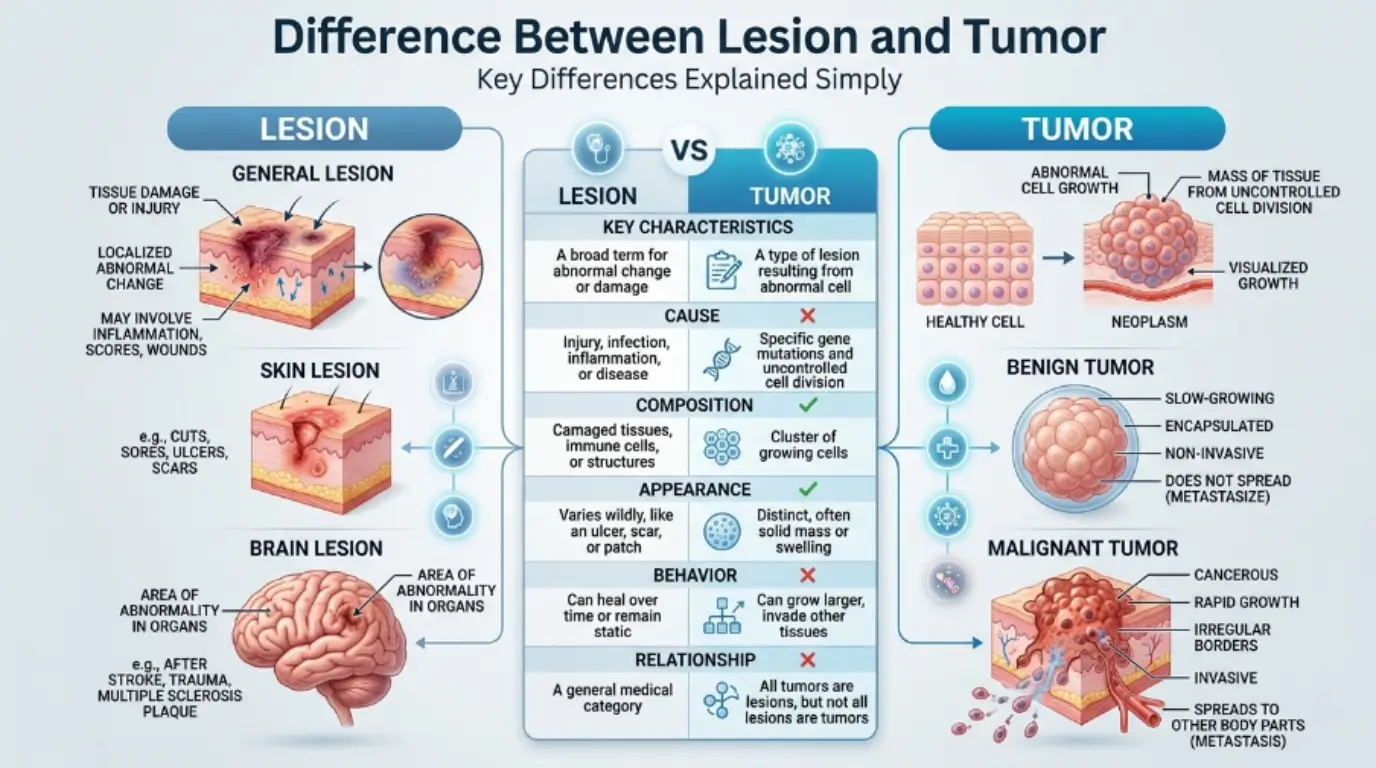
While a lesion refers to any abnormal change or damage in tissue, a tumor specifically refers to an abnormal growth of cells.
Knowing the difference between lesion and tumor helps people interpret medical information more accurately and reduces unnecessary fear.
This guide explains the difference between lesion and tumor, their characteristics, examples, similarities, uses in language, and much more in simple terms.
Key Difference Between Lesion and Tumor
A lesion is a broad medical term for any abnormal tissue change caused by injury, infection, disease, or trauma.
A tumor is a specific type of abnormal tissue growth caused by uncontrolled cell multiplication.
In simple words:
- All tumors can be considered lesions.
- Not all lesions are tumors.
Why Is Their Difference Important for Learners and Experts?
Understanding the distinction between lesions and tumors is valuable because:
- It improves medical communication.
- It helps patients understand diagnostic reports.
- It reduces confusion during treatment discussions.
- It assists students in learning pathology correctly.
- It helps doctors determine appropriate treatment plans.
- It improves research accuracy.
- It supports public health education.
- It helps identify disease severity.
- It aids in early diagnosis.
- It promotes informed healthcare decisions.
Pronunciation
Lesion
US: /LEE-zhən/
UK: /LEE-zhən/
Tumor
US: /TOO-mer/
UK: /TYOO-muh/
Understanding their pronunciation is helpful, but understanding their medical meanings is even more important. Let’s now explore the detailed difference between lesion and tumor.
Difference Between Lesion and Tumor
1. Definition
Lesion
A lesion is any abnormal change in body tissue.
Examples:
- Skin rash caused by infection.
- Brain lesion caused by multiple sclerosis.
Tumor
A tumor is an abnormal mass formed by excessive cell growth.
Examples:
- Benign lipoma.
- Malignant lung tumor.
2. Cause
Lesion
Can result from injury, infection, inflammation, or disease.
Examples:
- Burn lesion.
- Acne lesion.
Tumor
Usually develops because of abnormal cell division.
Examples:
- Breast tumor.
- Bone tumor.
3. Appearance
Lesion
May appear as discoloration, wound, scar, or damaged tissue.
Examples:
- Liver lesion.
- Skin lesion.
Tumor
Usually appears as a lump or mass.
Examples:
- Brain tumor.
- Thyroid tumor.
4. Growth Pattern
Lesion
May remain stable or heal naturally.
Examples:
- Bruise lesion.
- Healing ulcer lesion.
Tumor
Often continues growing over time.
Examples:
- Growing kidney tumor.
- Enlarging ovarian tumor.
5. Cancer Relationship
Lesion
Most lesions are not cancerous.
Examples:
- Eczema lesion.
- Psoriasis lesion.
Tumor
Can be benign or malignant.
Examples:
- Benign adenoma.
- Malignant melanoma tumor.
6. Tissue Damage
Lesion
Represents tissue damage or abnormality.
Examples:
- Stroke lesion.
- Oral lesion.
Tumor
Represents excessive tissue growth.
Examples:
- Pituitary tumor.
- Colon tumor.
7. Medical Diagnosis
Lesion
Often diagnosed through imaging and physical examination.
Examples:
- MRI-detected lesion.
- Skin lesion examination.
Tumor
Usually requires imaging and biopsy.
Examples:
- Breast biopsy.
- Brain tumor scan.
8. Treatment
Lesion
Treatment depends on the cause.
Examples:
- Antibiotics for infected lesion.
- Cream for skin lesion.
Tumor
May require surgery, chemotherapy, or radiation.
Examples:
- Tumor removal surgery.
- Chemotherapy treatment.
9. Risk Level
Lesion
Can range from harmless to serious.
Examples:
- Minor skin lesion.
- Severe brain lesion.
Tumor
May become life-threatening if malignant.
Examples:
- Benign uterine tumor.
- Cancerous pancreatic tumor.
10. Scope of the Term
Lesion
Broad medical category.
Examples:
- Skin lesion.
- Liver lesion.
Tumor
Specific medical condition.
Examples:
- Lung tumor.
- Prostate tumor.
Nature and Behavior of Lesions
Lesions represent tissue abnormalities. They may occur due to injury, disease, infection, inflammation, or trauma. Some lesions heal naturally, while others require medical treatment. Their behavior varies greatly depending on their underlying cause.
Nature and Behavior of Tumors
Tumors are abnormal cell growths. They can be benign, meaning non-cancerous, or malignant, meaning cancerous. Tumors may grow slowly or rapidly and can sometimes spread to other parts of the body.
Why Are People Confused About Their Use?
People often confuse lesions and tumors because both appear as abnormalities on medical scans. Doctors may initially identify an abnormal area as a lesion until further tests determine whether it is a tumor. Since many tumors are first detected as lesions on imaging studies, the terms are sometimes mistakenly used interchangeably.
Difference and Similarity Table
| Feature | Lesion | Tumor |
| Definition | Tissue abnormality | Abnormal cell growth |
| Scope | Broad term | Specific term |
| Cause | Injury, infection, disease | Uncontrolled cell division |
| Appearance | Damage or abnormal tissue | Mass or lump |
| Cancerous | Usually not | Can be |
| Growth | May not grow | Often grows |
| Treatment | Depends on cause | Depends on type |
| Examples | Rash, ulcer, scar | Lipoma, cancer |
| Diagnosis | Imaging, examination | Imaging, biopsy |
| Similarity | Both involve abnormal tissue changes | Both involve abnormal tissue changes |
Which Is Better in What Situation?
A lesion is not necessarily better or worse than a tumor because both are medical findings rather than conditions people choose. A small skin lesion caused by a minor injury is generally less serious than a malignant tumor. However, a severe brain lesion may be more dangerous than a benign tumor.
The seriousness depends on the location, cause, size, and impact on body functions. Medical evaluation is always necessary to determine the significance of either condition.
Lesion and Tumor in Metaphors and Similes
Lesion
Often symbolizes damage, emotional scars, or hidden problems.
Examples:
- The betrayal left a lesion on his trust.
- Her sadness spread like a lesion across her memories.
Tumor
Often symbolizes growing problems or harmful influences.
Examples:
- Corruption became a tumor within the organization.
- The conflict grew like a tumor in the community.
Connotative Meanings
Lesion
Connotation: Mostly Negative
Examples:
- Emotional lesion from past trauma.
- Social lesion affecting a community.
Tumor
Connotation: Strongly Negative
Examples:
- A tumor of corruption.
- A tumor of greed.
Idioms or Proverbs Related to Lesion and Tumor
There are no common English idioms specifically containing lesion or tumor, but similar expressions exist.
Examples:
- A growing problem is like a tumor.
- Old wounds leave lesions on the heart.
- The issue spread like a tumor.
- The scandal became a social tumor.
- Emotional lesions take time to heal.
Lesion in Literature
- The Magic Mountain – Thomas Mann (Novel, 1924)
- The Cancer Journals – Audre Lorde (Memoir, 1980)
- Illness as Metaphor – Susan Sontag (Essay, 1978)
Tumor in Literature
- The Emperor of All Maladies – Siddhartha Mukherjee (Non-fiction, 2010)
- Cancer Ward – Aleksandr Solzhenitsyn (Novel, 1968)
- When Breath Becomes Air – Paul Kalanithi (Memoir, 2016)
Movies Related to Tumors and Medical Conditions
Tumor-Related Movies
- 50/50 (2011, USA)
- My Sister’s Keeper (2009, USA)
- The Fault in Our Stars (2014, USA)
- Brain on Fire (2016, USA)
Lesion-Related Medical Films
- Awakenings (1990, USA)
- Patch Adams (1998, USA)
Frequently Asked Questions
Is every lesion a tumor?
No. A lesion is a broad term for any abnormal tissue change, while a tumor is a specific type of lesion involving cell growth.
Is every tumor a lesion?
Yes. Tumors are considered a type of lesion because they are abnormal tissue changes.
Can lesions become cancerous?
Some lesions can develop into cancer depending on their type and cause.
Are tumors always cancer?
No. Tumors can be benign (non-cancerous) or malignant (cancerous).
How are lesions and tumors diagnosed?
Doctors use physical examinations, imaging tests, laboratory studies, and biopsies when necessary.
How Both Are Useful for Understanding Our Surroundings
Lesions and tumors help healthcare professionals identify disease processes and monitor patient health.
Understanding these concepts improves public awareness of medical conditions and encourages early diagnosis.
Their study also contributes to advances in medicine, pathology, radiology, and cancer research, ultimately improving healthcare outcomes for society.
Conclusion
The difference between lesion and tumor lies mainly in their scope and meaning. A lesion is any abnormal change or damage in tissue, while a tumor is a specific growth caused by abnormal cell multiplication. Although the terms are related, they are not interchangeable.
Understanding the difference between lesion and tumor helps patients interpret medical reports more accurately and enables students and professionals to communicate clearly.
By recognizing their definitions, causes, behaviors, and medical significance, people can make better-informed healthcare decisions and appreciate the important role these concepts play in diagnosis and treatment.