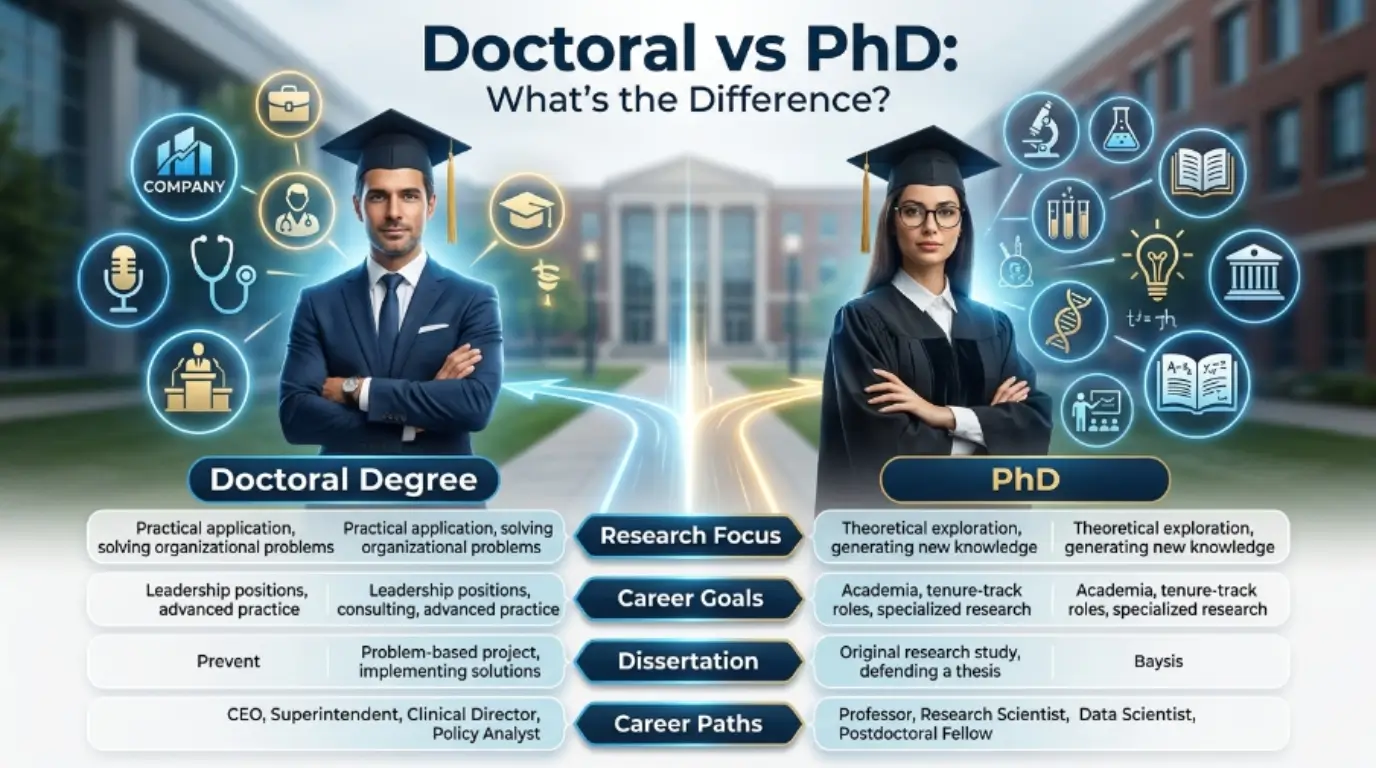
The terms doctoral and PhD are often used interchangeably, which creates confusion for many students and professionals. Imagine a teacher planning to continue higher education.
One university offers a doctoral degree, while another offers a PhD. At first glance, both options seem identical, but they have important differences in purpose and career outcomes.
Understanding the difference between doctoral and PhD programs helps students choose the right educational path. While both represent the highest level of academic achievement, they focus on different goals and professional applications.
The difference between doctoral and PhD degrees is important for researchers, educators, business professionals, and healthcare experts.
Knowing the difference between doctoral and PhD programs can save time, money, and effort when selecting an advanced degree. This guide explains the difference between doctoral and PhD degrees in simple language with practical examples.
Key Difference Between Doctoral and PhD
A doctoral degree is a broad category that includes several advanced degrees such as EdD, DBA, DNP, and PhD. A PhD is a specific type of doctoral degree focused mainly on original research and academic scholarship.
Why Is Their Difference Important?
Understanding these degrees helps students select programs that match their career goals. Researchers often choose PhDs, while professionals in education, healthcare, and business may prefer other doctoral programs. Society benefits because each degree develops experts who solve different kinds of problems.
Pronunciation
| Term | US Pronunciation | UK Pronunciation |
| Doctoral | DOK-tuh-rul | DOK-tuh-ruhl |
| PhD | Pee-Aitch-Dee | Pee-Aitch-Dee |
Now that the basic distinction is clear, let’s explore the detailed differences.
Difference Between Doctoral and PhD
1. Definition
Doctoral: An umbrella term covering all doctorate-level degrees.
Examples:
- Doctor of Education (EdD)
- Doctor of Business Administration (DBA)
PhD: A specific doctoral degree emphasizing research and theory.
Examples:
- PhD in Psychology
- PhD in Physics
2. Purpose
Doctoral: Solves practical workplace problems.
Examples:
- Improving school leadership
- Enhancing healthcare systems
PhD: Creates new knowledge through research.
Examples:
- Studying climate change
- Discovering medical treatments
3. Career Focus
Doctoral: Professional leadership roles.
Examples:
- School superintendent
- Healthcare administrator
PhD: Academic and research careers.
Examples:
- University professor
- Research scientist
4. Research Intensity
Doctoral: Research is often applied and practical.
Examples:
- Improving company productivity
- Evaluating educational methods
PhD: Research is highly theoretical and original.
Examples:
- New scientific theories
- Advanced mathematical models
5. Dissertation Requirements
Doctoral: May require a project or applied dissertation.
Examples:
- Business improvement plan
- Educational intervention study
PhD: Requires an original dissertation.
Examples:
- Multi-year scientific research
- Historical archive analysis
6. Program Structure
Doctoral: Often includes practical coursework.
Examples:
- Leadership training
- Professional practice seminars
PhD: Heavily focused on research methods.
Examples:
- Statistical analysis
- Research design
7. Target Students
Doctoral: Working professionals.
Examples:
- Principals
- Senior managers
PhD: Future scholars and researchers.
Examples:
- Academic researchers
- University lecturers
8. Time Commitment
Doctoral: Usually shorter.
Examples:
- Three-year EdD
- Three-year DBA
PhD: Often longer due to extensive research.
Examples:
- Five-year PhD in Biology
- Six-year PhD in Sociology
9. Funding Opportunities
Doctoral: Frequently self-funded.
Examples:
- Employer-sponsored DBA
- Self-funded DNP
PhD: Often receives research funding.
Examples:
- Research assistantships
- University scholarships
10. Outcome
Doctoral: Applies knowledge to real-world settings.
Examples:
- Improving hospital operations
- Managing educational reform
PhD: Generates new academic knowledge.
Examples:
- Publishing research papers
- Developing scientific theories
Nature and Behavior of Both
Doctoral
Doctoral programs are practical, professional, and career-focused. They emphasize applying existing knowledge to solve real-world challenges.
PhD
PhD programs are investigative, analytical, and research-centered. They focus on creating new knowledge and advancing academic understanding.
Why Are People Confused About Their Use?
People often use “doctoral” and “PhD” as synonyms because both represent the highest educational level. Since every PhD is a doctoral degree, many assume all doctoral degrees are PhDs. The overlap in academic status causes frequent confusion.
Difference and Similarity Table
| Feature | Doctoral | PhD | Similarity |
| Category | Broad degree category | Specific degree type | Both are doctorate-level |
| Focus | Professional practice | Research and theory | Both require advanced study |
| Research | Applied | Original | Both involve research |
| Career Path | Leadership roles | Academic roles | Both offer career advancement |
| Dissertation | Applied project possible | Original dissertation | Both require major final work |
| Prestige | High | High | Both respected worldwide |
Which Is Better in Different Situations?
A doctoral degree is better for professionals who want leadership positions in business, healthcare, education, or public service. These programs focus on solving practical challenges and improving professional performance. Individuals seeking promotion or specialized expertise often benefit more from a professional doctorate.
A PhD is better for those interested in teaching at universities, conducting research, publishing scholarly work, or contributing to academic knowledge. Students who enjoy investigation, theory, and discovery usually find a PhD more rewarding and aligned with their long-term goals.
How the Terms Are Used in Metaphors and Similes
Doctoral
- He approached the project like a doctoral expert solving a real-world puzzle.
- Her leadership was as polished as a doctoral professional.
PhD
- His curiosity was like a PhD researcher searching for hidden answers.
- She examined every detail as carefully as a PhD scientist.
Connotative Meanings
Doctoral
Positive
- Expertise
- Leadership
- Professional achievement
Example:
- Her doctoral degree opened doors to executive positions.
Neutral
- Advanced qualification
Example:
- He completed a doctoral program in education.
PhD
Positive
- Intelligence
- Innovation
- Scholarship
Example:
- Her PhD research influenced national policy.
Negative
- Sometimes viewed as overly theoretical
Example:
- Some critics believe PhD research lacks practical application.
Idioms or Proverbs Related to Learning and Expertise
- Knowledge is power.
- Learning never exhausts the mind.
- Practice makes perfect.
- The more you know, the more you grow.
- A wise person learns every day.
Works in Literature
Doctoral
- Doctor Faustus — Christopher Marlowe (Tragedy, 1592)
- The Masters — C. P. Snow (Academic Fiction, 1951)
PhD
- Lucky Jim — Kingsley Amis (Satirical Novel, 1954)
- Stoner — John Williams (Literary Fiction, 1965)
Movies Related to Academic Research and Doctorates
Doctoral
- The Paper Chase (1973, USA)
- Mona Lisa Smile (2003, USA)
PhD
- A Beautiful Mind (2001, USA)
- The Theory of Everything (2014, UK)
Frequently Asked Questions
Is a PhD a doctoral degree?
Yes. A PhD is one type of doctoral degree.
Are all doctoral degrees PhDs?
No. Degrees such as EdD, DBA, and DNP are also doctoral degrees.
Which degree is more respected?
Both are highly respected, but respect depends on the profession and purpose.
Which degree takes longer?
PhD programs often take longer because of extensive research requirements.
Can a doctoral graduate be called Doctor?
Yes. Graduates of doctoral and PhD programs can generally use the title Doctor.
How Both Are Useful for Society
Doctoral graduates improve organizations, schools, hospitals, and businesses through practical solutions. Their work directly impacts communities and professional environments.
PhD graduates contribute new discoveries, theories, and innovations that expand human knowledge. Their research helps solve scientific, technological, and social challenges worldwide.
Conclusion
The difference between doctoral and PhD degrees lies mainly in their focus and application.
A doctoral degree is a broad category that includes many professional and academic doctorate programs, while a PhD is a specific doctoral degree centered on original research and scholarly contributions.
Choosing between the two depends on your career goals. If you want to solve practical workplace problems and advance professionally, a doctoral degree may be ideal.
If you aim to conduct research, teach at universities, and create new knowledge, a PhD is often the better choice.
Both paths represent outstanding educational achievement and contribute significantly to society through expertise, leadership, innovation, and lifelong learning.